Air Force Presses On with B-52 Modernization After Fatal Edwards AFB Crash
Posted By
Common Defense
On
In
National Security,News |
No Comments
The U.S. Air Force is refusing to let tragedy derail its mission.
Despite the devastating June 16 crash[1] of the first modernized B-52 Stratofortress at Edwards Air Force Base that claimed eight lives, the service announced it will continue pushing ahead with the aircraft’s extensive modernization program.
The move underscores a hardened commitment to ensuring America’s air dominance endures well into the mid-21st century.
Officials confirmed late Monday that the Air Force Safety Investigation Board has already begun its work to determine the cause of the crash.
The Radar Modernization Program (RMP) office will assist investigators throughout the process, but leadership made it clear that the radar upgrade effort will continue moving forward even as the investigation unfolds.
According to the Air Force, a second B-52H equipped with the new radar system will arrive at Edwards later this year to resume testing once the 412th Test Wing gives approval.
The decision reflects a determination to stay on schedule for modernization milestones[2], even while honoring those lost in the tragic accident.
The aircraft that went down had completed a ferry flight from Boeing’s San Antonio facility after receiving its new Active Electronically Scanned Array (AESA) radar built by Raytheon Technologies.
Image Credit: DoW
The AESA replaces the bomber’s outdated radar, vastly improving navigation, targeting precision, and situational awareness in all weather conditions. Similar radar technology has already proven itself on the Air Force’s F-15 Eagle and the Navy’s F/A-18 Hornet.
“The B-52 radar modernization ensures this aircraft remains the cornerstone of American airpower,” said Secretary of the Air Force Troy Meink prior to the crash. “We are committed to extending the life of this vital platform to operate alongside next-generation aircraft.”
Testing of the upgraded bomber was slated to continue through 2026, leading up to a full production decision later that year.
The radar modification marks the first major milestone in a sweeping program to transform the B-52H into what will eventually be designated the B-52J model—a revitalized powerhouse ready to serve for decades longer.
The modernization program is part of the Air Force’s strategic plan to condense its bomber fleet down to two airframes: the advanced stealth B-21 Raider and the new B-52J.
As those programs advance, legacy B-1B and B-2 bombers will be gradually phased out, concentrating resources on the platforms deemed most capable of meeting tomorrow’s threats.
Image Credit: DoW
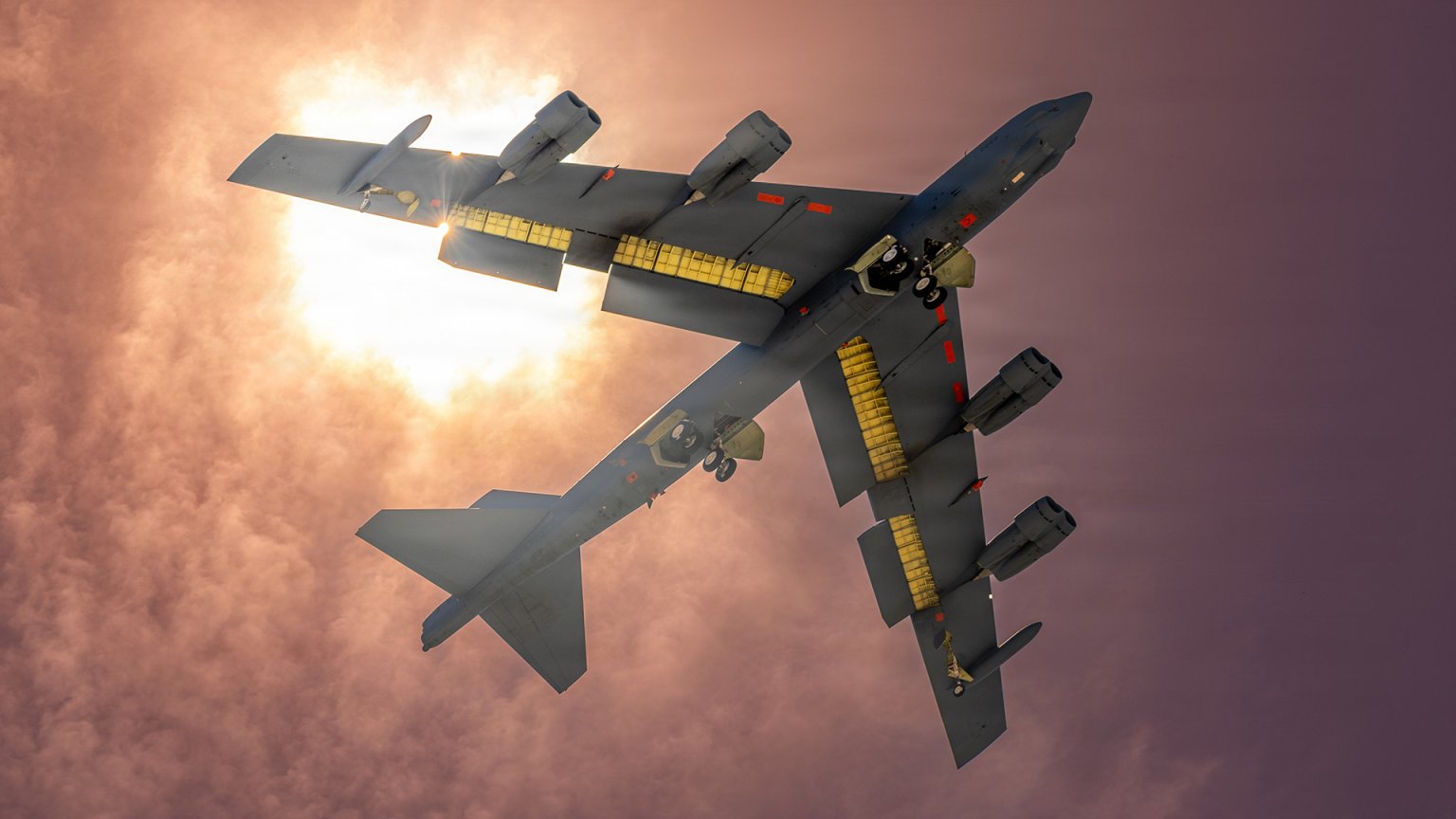
A B-52H Stratofortress from Edwards Air Force Base, California, departs for an evening test mission on Aug. 7, 2025. Air Force photo by Todd Schannuth.
The B-52 program’s scope stretches far beyond radar. Alongside the upgrade comes the Commercial Engine Replacement Program, which will finally replace the bomber’s eight aging 1960s Pratt & Whitney TF33 engines with modern Rolls-Royce F130s.
The result will be improved fuel efficiency, range, and reliability, effectively giving these Cold War-era giants new life.
Beyond new engines, the Stratofortress fleet is also slated for sweeping avionics, communications, and weapons upgrades, allowing it to maintain nuclear and conventional strike capabilities across global theaters.
The Air Force has described the B-52 as a continuing symbol of deterrence—one capable of responding decisively to any threat.
Air Force Chief of Staff Gen. Kenneth Wilsbach reaffirmed that sentiment, stating, “The B-52 will continue to serve as an unmatched symbol of U.S. airpower. With these upgrades, the aircraft remains ready to execute deterrence and strike missions for decades.”
It’s hard to argue with that assessment. The B-52 first flew in April 1952, and even now, more than 70 years later, it is still flying stronger than most aircraft designed half a century later.
Image Credit: DoW
A U.S. Air Force B-52 Stratofortress aircraft refuels from a KC-135 Stratotanker aircraft over the U.S. Central Command area of responsibility, during Operation Epic Fury, March 26, 2026. (U.S. Air Force photo)
Of the 744 Stratofortresses built between 1952 and 1962, roughly 75 B-52H models remain in service today. Each continues to serve as a testament to American engineering and the unmatched dedication of those who fly and maintain them.
The loss of eight airmen at Edwards was a painful reminder of the risks that come with progress.
But within the Air Force, the prevailing tone is one of resolve. The crash investigation will proceed meticulously, but the mission continues because the future of U.S. strategic airpower depends on it.
As tragic as the accident was, halting modernization now would risk far more than a schedule delay.
It would jeopardize the backbone of the Air Force’s long-range strike capability—a platform that still intimidates adversaries from Moscow to Beijing.
The message is clear: mourning does not mean surrendering forward momentum.
For a nation that depends on technological superiority and readiness, the decision to move forward isn’t just prudent—it’s imperative.
The B-52 may have been conceived in the early days of the Cold War, but under new leadership and modern systems, it’s poised to remain America’s airborne workhorse for the 21st century and beyond.
![U.S. Air Force Probes B-52 Near Miss with SkyWest Passenger Jet in North Dakota [WATCH]](https://www.commondef.com/wp-content/uploads/2025/07/2025.07.22-11.58-commondefense-687f7cce2cb27.avif)