Marine Corps F/A-18 Hornet Crashes Near Mount Rainier, Ignites Washington Wildfire
Posted By
Common Defense
On
In
National Security,News |
No Comments
A Marine Corps F/A-18 Hornet went down near Mount Rainier in Washington state this afternoon, triggering a fast-spreading wildfire that forced emergency evacuations and prompted aerial firefighting efforts.
The crash unfolded around noon, according to the 3rd Marine Aircraft Wing, and involved a jet from Marine Aircraft Group 11 that “experienced a non-fatal aviation mishap while conducting routine training.”
Fortunately, the pilot ejected safely and was quickly recovered by the local sheriff’s department, the Marine Corps confirmed. The pilot was then transported to a nearby hospital for evaluation, a precautionary measure following what could have been a dire situation.
The Naches Fire Department, which rushed to contain the resulting blaze, reported that the crash occurred near Rimrock Lake, roughly southeast of Mount Rainier — a rugged region already prone to wildfires during this time of year.
Fire crews immediately deployed helicopters and ground engines to stop the fire from advancing toward populated areas and campsites.
By late afternoon, local officials had issued evacuation orders for campers and hikers as the flames advanced through the forested terrain. “The area should be avoided for the foreseeable future,” the Naches Fire Department warned in a public notice around 4:45 p.m. as smoke filled the sky.
The 3rd Marine Aircraft Wing said the cause of the crash is under investigation, and the Marine Corps has already initiated standard safety and mechanical reviews to determine what went wrong. Incidents like this are rare, but when they occur, the military moves fast to isolate the root cause and prevent repetition.
Image Credit: DoW
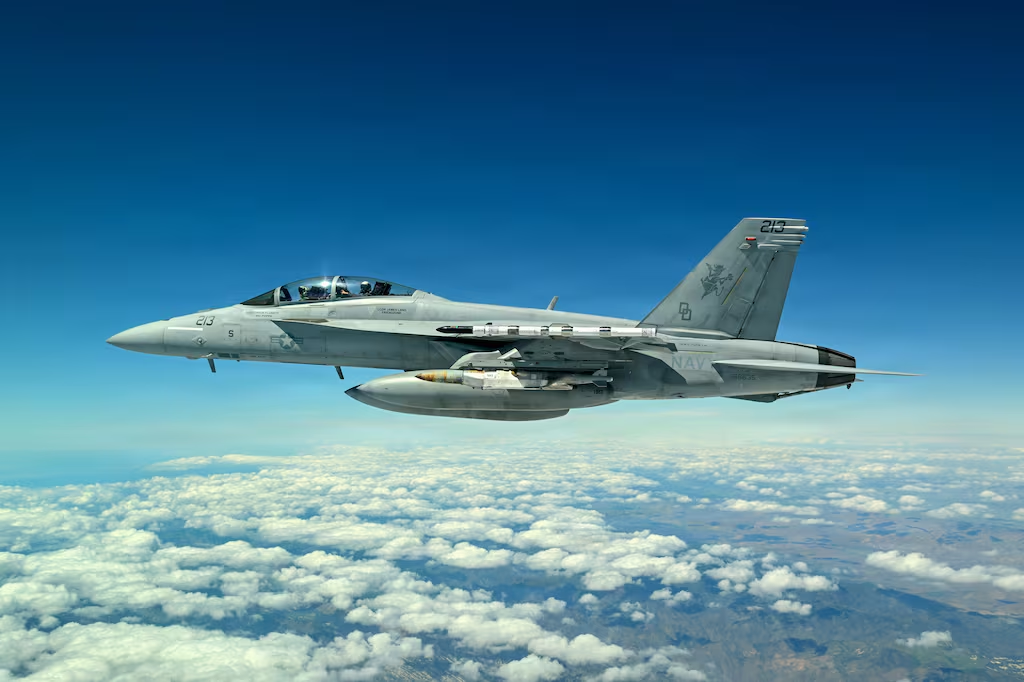
A Navy F/A-18 carries the new JDAM-LR variant during a test in early April. (U.S. Navy)
While the pilot’s survival is a small miracle considering the mountainous terrain, questions remain about whether aging airframes might be contributing to recent training mishaps.
Many Marine Corps F/A-18s have been serving since the Cold War era, though modernization efforts are underway under the leadership of President Trump’s renewed push to rebuild America’s fighting force.
The accident is another reminder that training is not without danger. These are not simple flights — they are complex war-readiness operations designed to keep Marine aviators sharp, capable, and prepared for combat missions worldwide. Sometimes that edge cuts close, and the sacrifices and risks remind Americans of the reality behind the uniform.
Notably, this wasn’t the first aviation incident in the same general area. In October 2024, a Navy EA-18G Growler went down during a routine flight near Mount Rainier, tragically killing both crew members.
That crash led to a major multi-day search operation that included a Navy surveillance aircraft and soldiers from the Army’s elite 1st Special Forces Group. The terrain’s rugged nature complicates both training and recovery efforts.
According to local fire officials, the new wildfire is under control, though crews remained on standby overnight to monitor hotspots and prevent flare-ups. The quick reaction from the Marines and local authorities likely prevented a much larger disaster.
Image Credit: DoW
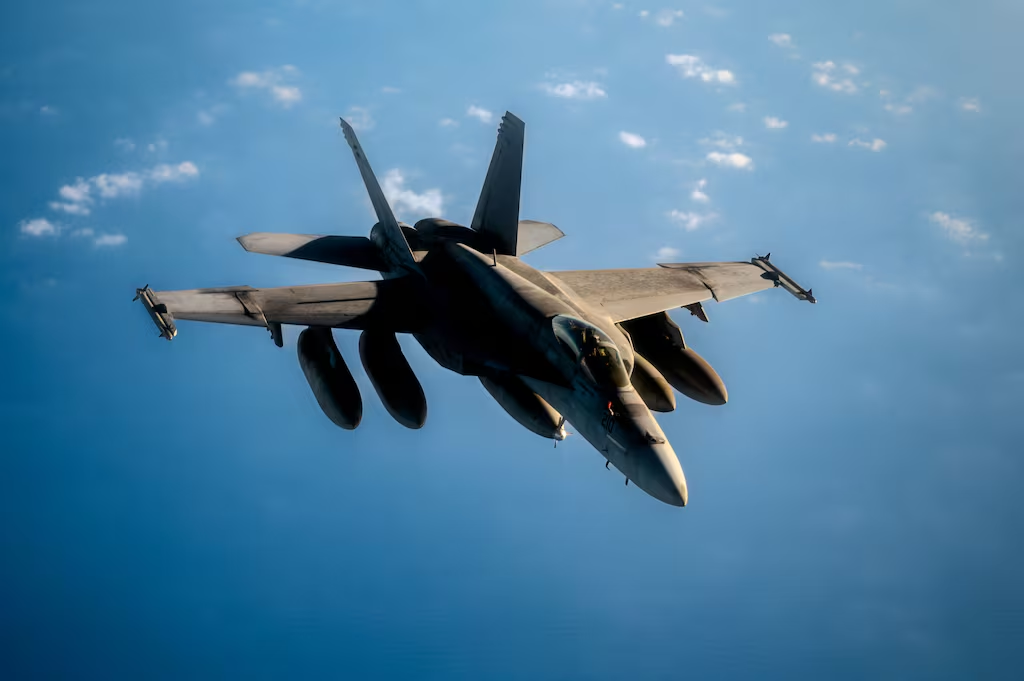
Search and rescue teams safely recovered a Navy pilot off the coast of Virginia after the pilot ejected from an F/A-18E Super Hornet, like the one shown here, on Wednesday. (Staff Sgt. Jackson Manske/U.S. Air Force)
Local residents reported hearing the jet’s engine roaring over the lake before a loud explosion echoed through the valley.
Smoke rose quickly, and within minutes, first responders were mobilized. Witnesses said the pilot’s parachute was visible in the sky shortly after the sound of impact, a clear sign his ejection system worked flawlessly under pressure.
For the Marine Corps, training in varied and challenging environments like Washington’s mountainous regions is critical for combat readiness.
These aviators routinely train under demanding weather and terrain conditions to replicate real-world conflict zones where split-second decisions can mean life or death.
The War Department remains focused on improving safety and equipment reliability, all while maintaining the high operational tempo necessary to prepare for global threats. Training intensity isn’t expected to slow down — if anything, under Secretary of War Pete Hegseth and President Trump’s national defense goals, the pace of readiness exercises will continue to accelerate.
Washington firefighters, meanwhile, are now working closely with military personnel to clear debris and secure the crash site.
Image Credit: DoW
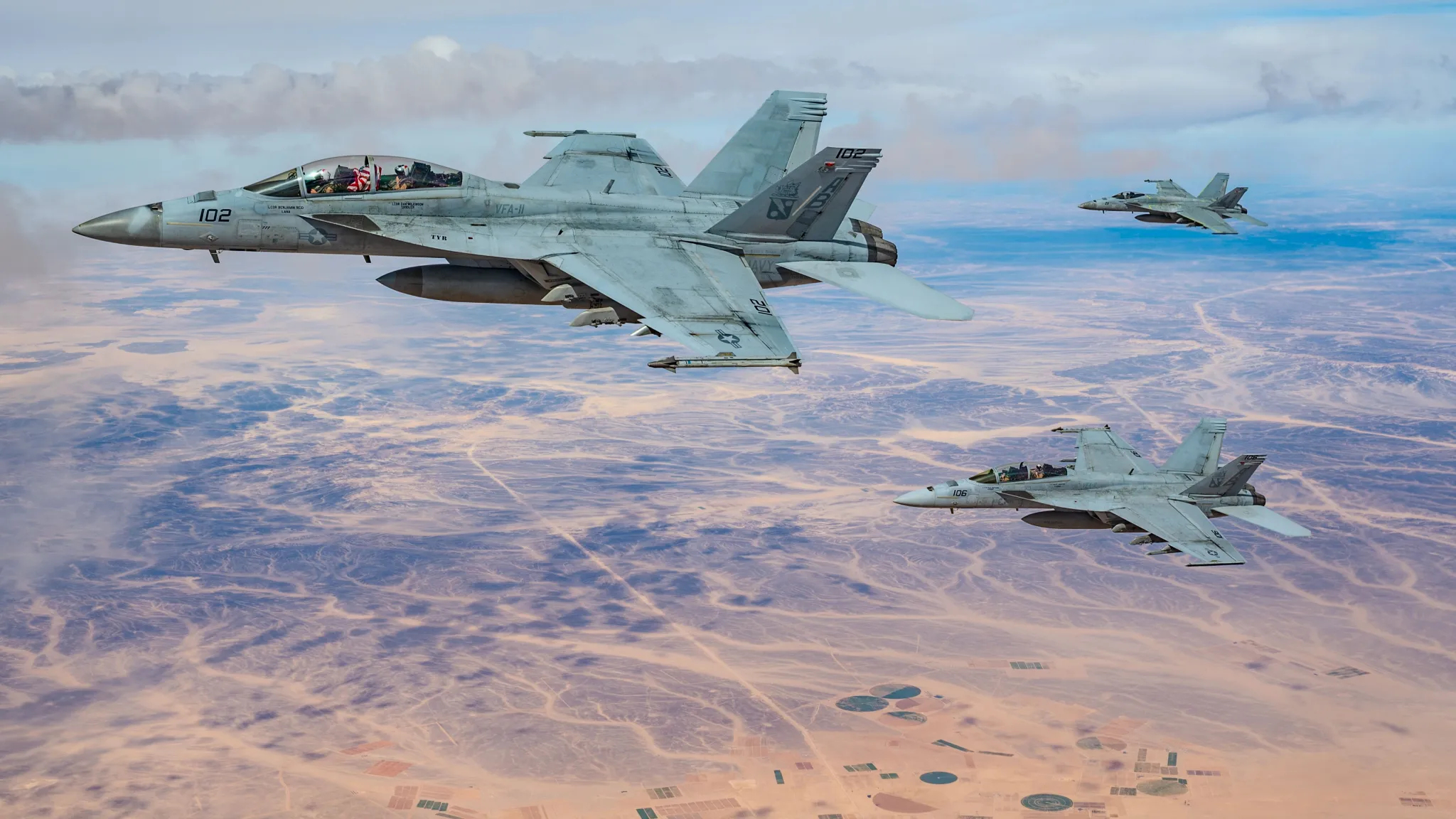
Navy F/A-18 Super Hornets from the Harry S. Truman Carrier Strike Group fly a mission over the Middle East March 3, 2025. Air Force photo by Staff Sgt. Jackson Manske.
Once the wreckage cools and the region is deemed safe, Marine investigators will assess data from the aircraft’s systems and review the pilot’s communications before and during the incident.
The U.S. Marine Corps takes every crash seriously, not just for accountability but for the larger mission of ensuring America’s air superiority remains unmatched.
Every lesson learned contributes to safer skies and stronger pilots — and today’s incident, while alarming, underscores the inherent courage of those who train to defend the nation.
Despite the dramatic nature of the event, local officials praised both the Marines and the first responders for acting quickly and effectively. Their coordination prevented injury to civilians and contained a potentially devastating wildfire before it could threaten nearby communities.
At a time when America’s enemies are watching for weakness, the Marines are proving, yet again, that even in moments of crisis, resolve and discipline carry the day.