Marines Bolster Indo-Pacific Might With New Anti-Ship and Air Defense Platforms in Okinawa
Posted By
Common Defense
On
In
National Security,News |
No Comments
U.S. Marines stationed in Okinawa are stepping up their game in a big way.
The installation has now formally received its first sets of next-generation systems — the Navy-Marine Expeditionary Ship Interdiction System (NMESIS) and the Marine Air Defense Integrated System (MADIS).
Both weapons platforms mark a critical leap forward in the Corps’ ability to fight and win in the increasingly contested Indo-Pacific arena.
The 12th Marine Littoral Regiment, part of the 3rd Marine Division, welcomed the two platforms as essential upgrades to their mission profile.
The delivery is part of a broader modernization effort to ensure Marine forces remain lethal, agile, and ready to hit back at hostile threats from the sea or sky.
The NMESIS is not just another missile launcher. It’s a ground-based anti-ship weapon designed specifically for sea denial operations — a key function in preventing enemy ships from gaining the upper hand near allied coastlines. Essentially, it gives the Marines the power to control entire maritime zones without needing traditional naval support.
That’s a serious message to Beijing, whose naval buildup and island encroachments continue to test America’s resolve.
This system carries the Naval Strike Missile (NSM), one of the world’s most advanced ship-killing weapons. Mounted on a Joint Light Tactical Vehicle, NMESIS can fire both in semi-autonomous and fully autonomous modes, ensuring maximum flexibility for expeditionary operations.
In plain language, that means Marines can take out enemy ships even from small, forward island bases — no warship required.
Image Credit: DoW
Soldiers assigned to 1st Battalion, 27th Infantry Regiment and 65th Brigade Engineer Battalion, 25th Infantry Division, performed an air assault mission during Indo-Pacific Army Chiefs Conference (IPACC) on Schofield Barracks, Hawaii, Sept. 10-13, 2021. Soldiers performed breaching skills and insertion skills on a marked objective. (U.S. Army photo by Pfc. Daniel Proper, 25th Infantry Division)
If NMESIS covers the oceans, MADIS dominates the skies. The Marine Air Defense Integrated System is a short-range but highly capable air defense solution mounted on two 4×4 tactical vehicles.
The first vehicle hunts and disables drones or other low-altitude airborne threats through 360-degree radar coverage, an electronic warfare suite, and command-and-control systems. The second vehicle packs a punch with its multi-Stinger missile pod, a 30mm cannon, and its own electronic warfare tools.
Together, the pair forms a deadly mobile duo that can respond to everything from quadcopters to enemy helicopters or fighter jets.
The flexibility of the MADIS allows Marines to counteract the swarm drone tactics used by adversaries like China and Iran, whose cheap but dangerous unmanned aircraft systems have been wreaking havoc in various theaters.
Image Credit: DoW
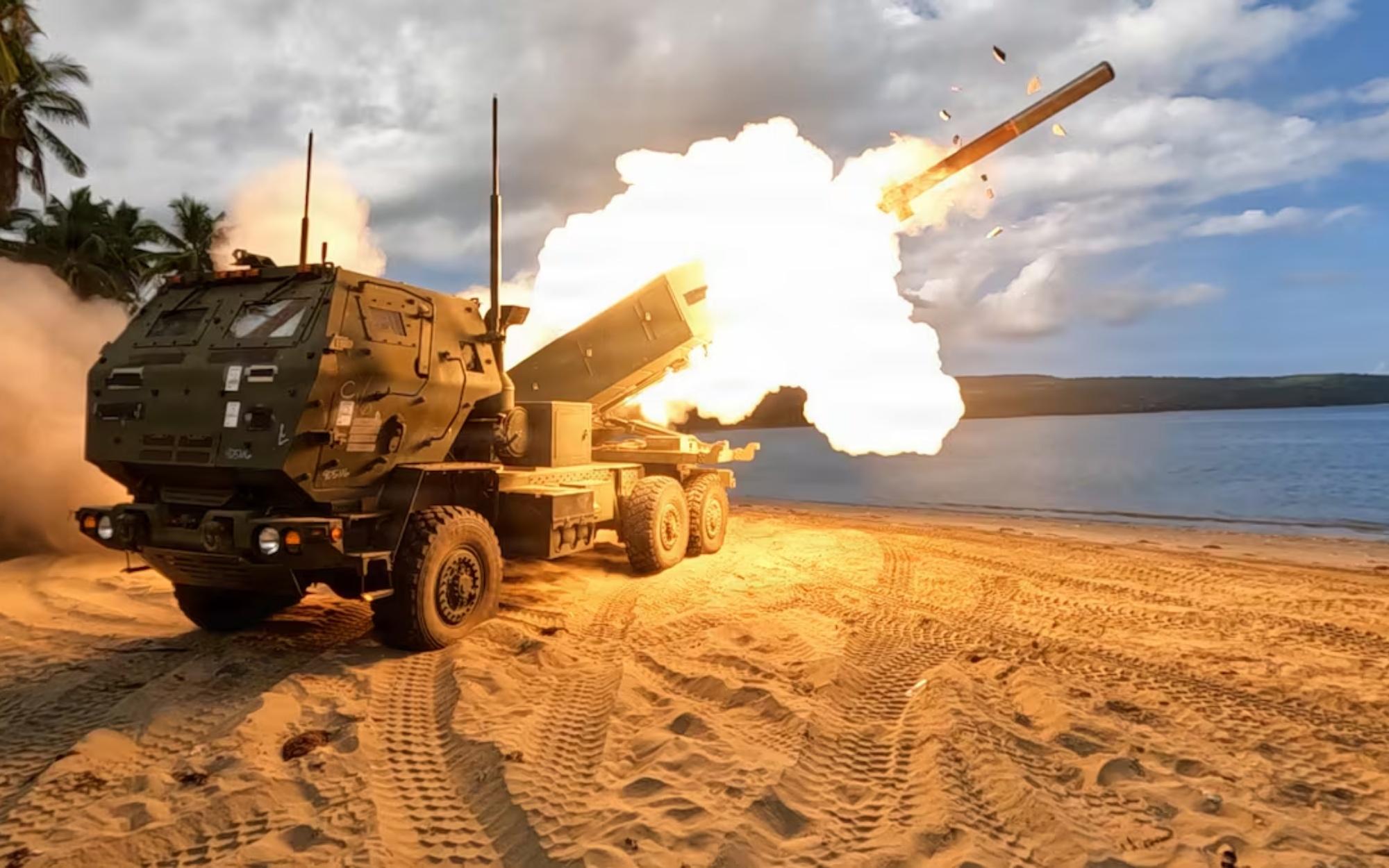
Army soldiers fire M142 High Mobility Artillery Rocket Systems (HIMARS) as part of Operation Epic Fury. Army photo.
This isn’t the first time the Corps has fielded these systems in the Indo-Pacific, but Okinawa’s deployment underscores the U.S. commitment to maintaining deterrence right on the front line of potential conflict.
The Hawaii-based 3rd Marine Littoral Regiment was the first to receive NMESIS and MADIS, and has since proven their worth in multiple exercises across the Pacific theater.
Back in May, Marines with the 3rd MLR demonstrated the NMESIS’s capabilities during the Balikatan 26 exercise with the Philippines.
They moved their launchers across the Batanes Islands via Air Force C-130Js and Army landing craft — a clear illustration of how joint mobility can expand Marine Corps reach. For three days, they ran mock fire missions, practicing ship interdiction tactics designed to deny adversaries access to the strategically vital Luzon Strait.
Image Credit: DoW
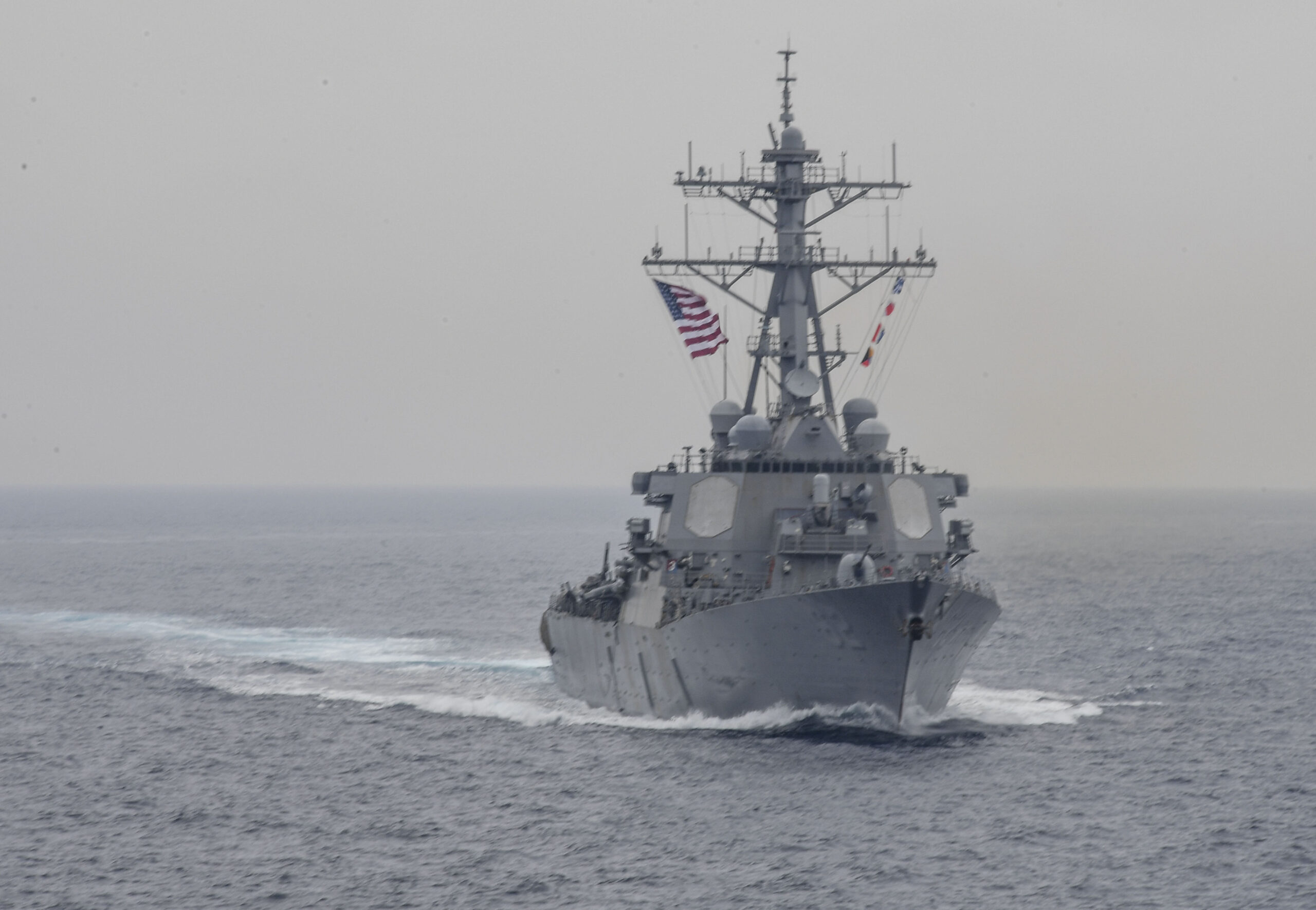
170601-N-RM689-190 SEA OF JAPAN (June 1, 2017) Arleigh Burke-class guided-missile destroyer USS Fitzgerald (DDG 62) sails in formation during a bilateral exercise between USS Carl Vinson and USS Ronald Reagan carrier strike groups and the Japanese Maritime Self-Defense Force (JMSDF). The Ronald Reagan and Carl Vinson Carrier Strike Groups conduct maritime training operations with Japan Maritime Self-Defense Force ships, JS Hyuga (DDH 181) and JS Ashigara (DDG178). JMSDF and U.S. Navy forces routinely train together to improve interoperability and readiness to provide stability and security for the Indo-Asia Pacific region. (U.S. Navy photo by Mass Communication Specialist 3rd Class Kelsey L. Adams/Released)
At nearly the same time, Marines in Zambales showcased the MADIS’s abilities by knocking drones out of the sky.
Those live demonstrations weren’t just drills — they were proofs of concept showing that the Corps can relocate quickly, set up shop on any island, and dominate any battlespace, whether air or sea.
The integration of MADIS and NMESIS also signals a larger shift in Marine Corps doctrine under the “Force Design” modernization plan.
The focus now is speed, deception, and lethality. By cutting down heavy legacy systems in favor of agile, high-impact platforms, the Corps is aligning itself for what modern conflict really demands — the ability to strike fast, move faster, and vanish before the enemy can respond.
Image Credit: DoW
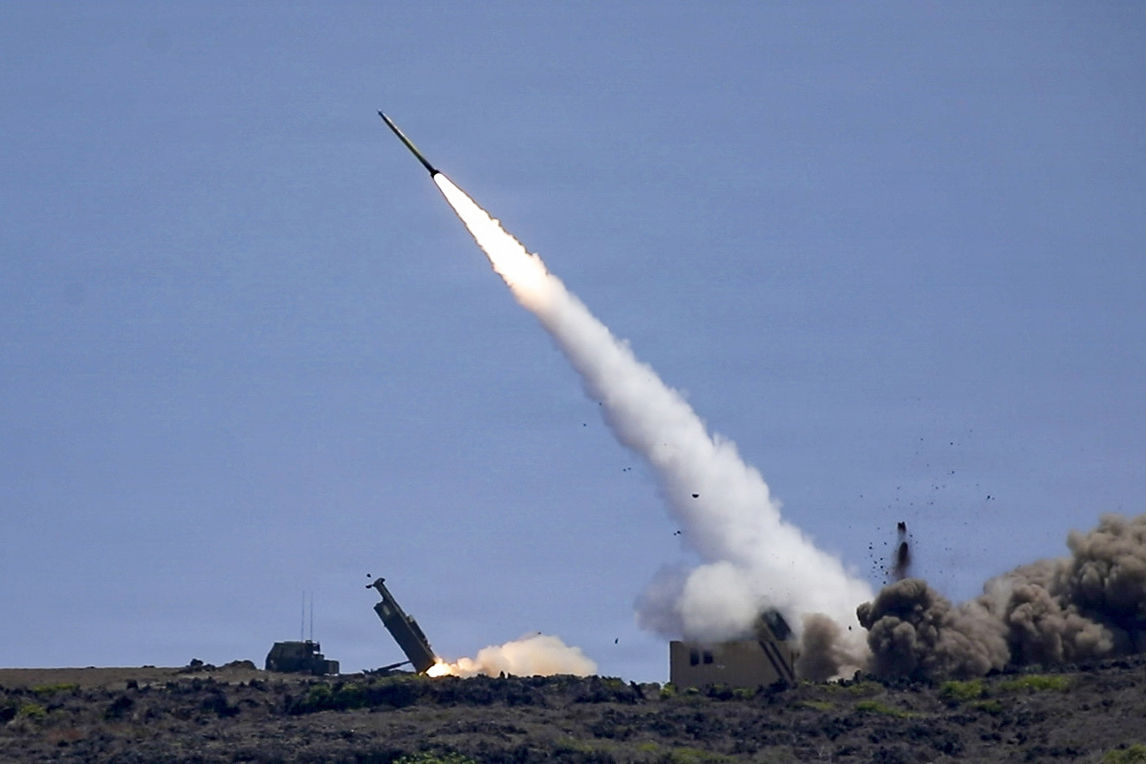
An M142 HIMARS operated by the 7th ID/MDC-PAC launches a missile from Palawan, Philippines, during a live-fire exercise, Apr. 27, 2026. (Staff Sgt. Brandon Rickert/U.S. Army)
Secretary of War Pete Hegseth’s emphasis on restoring America’s warrior mindset and strengthening Pacific readiness is paying off.
These systems are a direct result of that approach — a return to the expeditionary, hard-hitting Marine Corps built to deter adversaries through strength, not endless diplomacy.
And make no mistake, the timing is intentional. With Chinese warships prowling near Taiwan, and North Korea testing missiles like it’s their national sport, the U.S. presence in Okinawa has never been more essential.
Every piece of hardware that expands Marine capability sends one message loud and clear: America is not retreating from the Pacific — we’re reinforcing it.
The Marines’ new tech arsenal represents more than just shiny equipment; it’s the embodiment of deterrence through readiness.
Image Credit: DoW
U.S. Soldiers assigned to the 7th Infantry Division (Multi-Domain Command – Pacific) shoot artillery during Exercise Balikatan 2026 at Cape Bojeador, Philippines, May 6, 2026. Balikatan is a longstanding annual exercise between the Armed Forces of the Philippines and U.S. military that represents the strength of our alliance, improves our capable combined force, and demonstrates our commitment to regional peace and prosperity. (U.S. Army photo by Staff Sgt. Jameson Harris)
By giving our warriors the tools to neutralize threats from both land and sea, the War Department ensures that any adversary thinking about challenging American dominance in the Indo-Pacific will have to think twice.
The enemy’s calculus just got a lot more complicated, and that’s exactly how the Marines like it — ready, forward, and unapologetically lethal.