Pentagon Launches New ‘Joint Warfighting Evaluation’ To Tighten Standards For Flag Promotions
Posted By
Common Defense
On
In
National Security,News |
No Comments
The War Department is rolling out a sweeping new requirement aimed at strengthening the quality and readiness of America’s top military officers.
The initiative, dubbed the “Joint Warfighting Evaluation,” will serve as a new qualifier for officers seeking promotion from O6 to O7, marking their entry into the general and admiral ranks.
According to a memo from Undersecretary of Personnel and Readiness Anthony Tata, the evaluation will assess an officer’s operational analysis, communication, and decision-making skills in a “rigorous and standardized” manner.
The goal is to ensure that only the most capable and strategically minded officers are entrusted with senior command responsibilities.
“The evolving character of war and complexities of the global security environment demand a rigorous and standardized method for evaluating core competencies of our joint warfighters,” Tata stated in his May 28 memo.
He made clear that this program is designed to strengthen the military’s internal talent systems and bolster the leadership core for future conflicts.
The Pentagon has yet to publicly release more details about the evaluation process, but Tata’s memo confirms the formation of an “Operational Planning Team” charged with developing the new assessment standards.
The move reflects a growing push toward accountability and measurable performance across the armed forces.
Image Credit: DoW
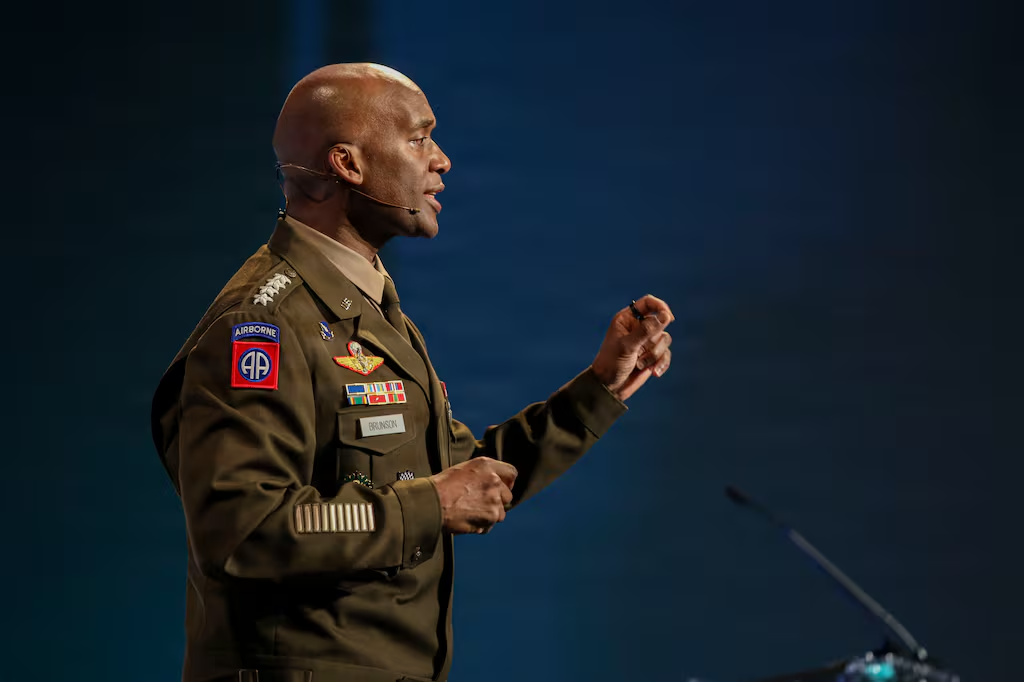
U.S. Army Gen. Xavier T. Brunson speaks at LANPAC in Honolulu, Hawaii, May 12, 2026. (Sgt. Daniela Lechuga Liggio/U.S. Army)
An O6 is typically a colonel in the Army, Air Force, and Marine Corps or a captain in the Navy. Promotion to O7 marks the start of the elite flag officer tier—brigadier general or rear admiral (lower half)—where officers begin to shape national-level strategy and lead large formations of warfighters.
Katherine Kuzminski, of the Center for a New American Security, noted that this updated approach builds upon existing law, not a departure from it. “The updated policy is an evolution of current law and policy, rather than a break from it,” she explained.
The foundation for joint assignments traces back to the 1986 Goldwater-Nichols Act, which mandated cross-branch experience as a prerequisite for promotion to general or admiral ranks.
Under that law, officers must serve a minimum of 22 months in joint duty posts—roles that expose them to multi-branch operations across combatant commands, the Joint Staff, or the Department of War. This experience aims to create leaders capable of synchronizing air, land, sea, space, and cyber capabilities in modern warfighting.
The new evaluation could bring fresh accountability to a system that, in some cases, has become more about time in service than demonstrated excellence. Kuzminski suggested that the Operational Planning Team can “take the strengths of the existing Goldwater-Nichols requirements (which can be treated as simply a ‘box checking’ exercise)” and turn them into a more meaningful test of leadership ability and joint command readiness.
Image Credit: DoW
The memo reveals that former Marine Lt. Col. Stuart Scheller will chair the committee overseeing this overhaul. Scheller, who drew national attention for publicly criticizing the disastrous U.S. withdrawal from Afghanistan, has emerged as a serious reformer since joining Tata’s office in 2025 as a senior advisor. His inclusion signals a shift toward merit-driven assessments and away from bureaucratic complacency.
Scheller echoed that sentiment in a recent social media post responding to coverage of War Secretary Pete Hegseth’s earlier directive pushing “joint warfighting ability” into all promotion evaluations.
“We need objective markers when it comes to meritocracy in the military selection system. We need the best warfighters to demonstrate their ability to solve a military problem,” Scheller wrote.
Hegseth’s reforms have focused on restoring lethality and merit-based advancement across the force. The addition of the Joint Warfighting Evaluation aligns with his broader campaign to identify and promote officers who can command effectively under real-world combat pressure, not just navigate Washington’s paper trails.
Image Credit: DoW
For decades, promotion boards have faced criticism for valuing bureaucratic checklists over battlefield competence. Hegseth and Tata appear determined to break that mold, creating an evaluation that reflects the demands of modern warfare against peer adversaries like China and Russia.
The objective is clear: sharpen America’s warrior edge and ensure that future generals and admirals earn their stars through tactical brilliance, not career maneuvering.
As the Operational Planning Team gets to work, all eyes across the military establishment will be on how this new evaluation reshapes the path to senior leadership.
If executed properly, it could return America’s highest ranks to a performance standard rooted in combat skill, decision-making under fire, and an unshakable commitment to victory.