British commandos executed one of the most daring and technically dangerous rescue missions imaginable, parachuting into one of the planet’s most isolated places to save a sick man.
The rarely used tandem jump technique they employed is a feat so complex and grueling that even among elite troops it’s considered a badge of honor.
The May mission began in England, where a specially trained team of six Pathfinders from the 16 Air Assault Brigade took off on a 7,000-mile flight to the British territory of Tristan da Cunha.
This lonely dot in the southern Atlantic is known as the most remote inhabited island on Earth, accessible only by ship — that is, unless an elite military unit decides to drop in from the sky.
The life-or-death call came when a local man developed symptoms consistent with Hantavirus, a deadly disease that can spiral fast without medical aid.
With no runway, no hospital, and no hope of reaching help in time by sea, Britain’s airborne specialists were sent in.
Two of the Pathfinders carried medical personnel as passengers during the jump — one a doctor, the other a critical care nurse. Each medic was rigged to a commando through a custom two-person parachute harness. They also carried an oversized equipment bundle containing the tools and medicines needed to treat the patient once they landed.
This was no routine operation. Tandem military jumps are as rare as they come, requiring a perfect blend of specialized skill, physical toughness, and trust.
The technique first came from the civilian skydiving world, developed in the 1980s and refined for military conditions by the 1990s. It turned the skydive into a literal lifeline rather than a thrill ride.
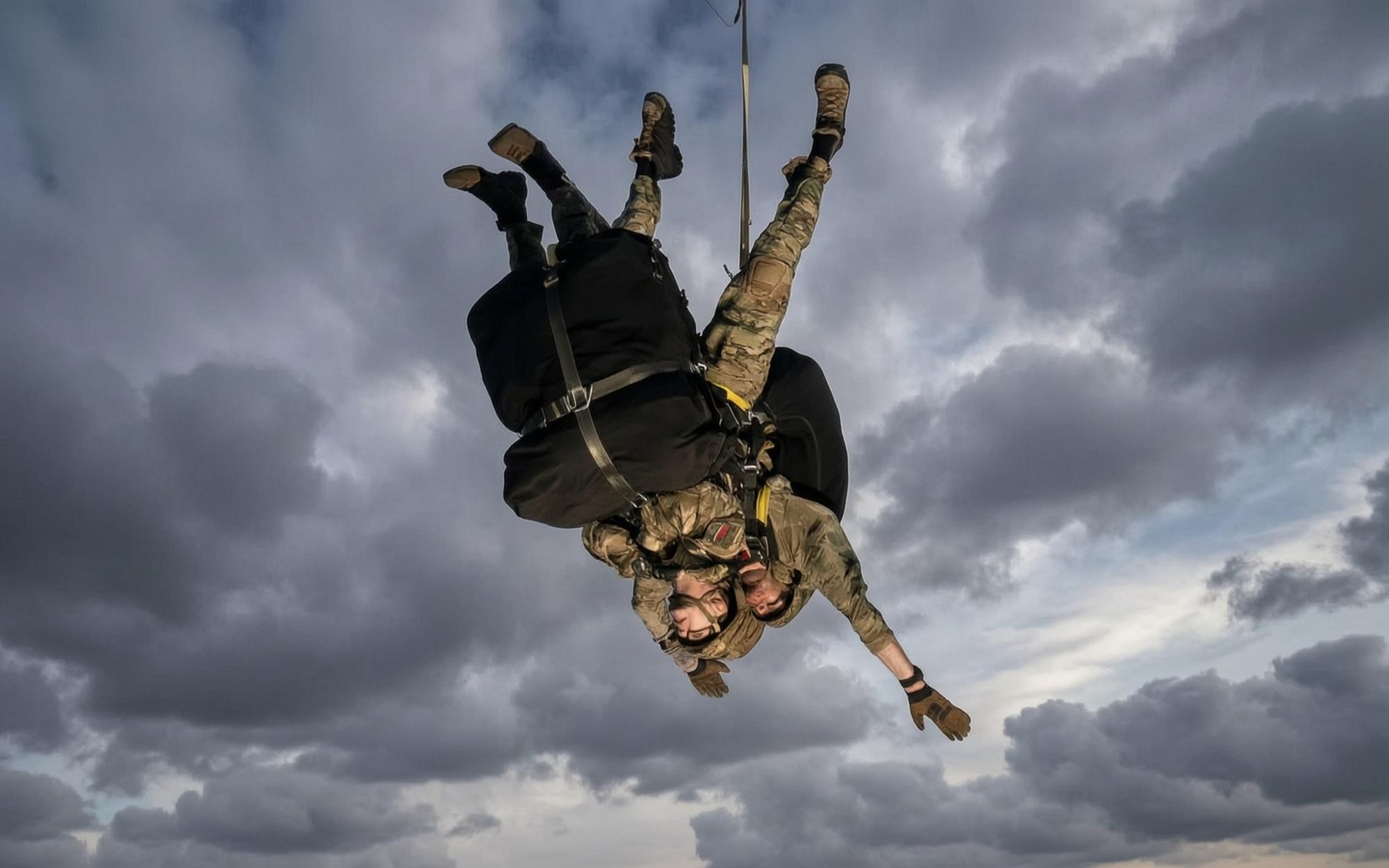
Ted Booth, the civilian parachuting visionary who refined tandem skydiving, might have never guessed how his invention would evolve into a battlefield and rescue necessity.
What began as a tool for training civilians became a means to drop doctors into war zones, insert commandos onto mountain peaks, or deliver critical care in hopelessly isolated regions.
By the time the U.S. military adopted the technique, it was transformed. American Army Special Forces, Air Force Pararescue, Marine recon units, and Navy SEALs all developed methods to jump with people or even cargo strapped underneath them — a backbreaking practice known as “jumping the barrel.”
Jumping a barrel is brutal discipline. Operators freefall with hundreds of pounds attached, often equipment vital to the mission, only to be yanked by gravity and straps midair before the parachute opens.
The physical punishment and precision timing it demands separate the elite from everyone else.
Becoming a qualified tandem master remains one of the hardest-earned credentials in special operations. U.S. troops earn the badge through a punishing three-week course at the Army’s Military Freefall School in Yuma, Arizona. Only a few advance to tandem master status — typically veterans with dozens or even hundreds of jumps already logged.
Even now, most special operations teams have just a handful of tandem masters on call. A 2012 Air Force report noted that while all pararescuemen complete freefall training, only about one in twelve qualify for tandem work. It’s a skill reserved for missions where failure cannot be an option.
For all its danger, the tandem capability has saved lives across the globe. U.S. operators have used it to drop medical teams into crisis zones and to deliver specialists into hostile combat areas.
From Afghanistan’s rugged wilderness to South Atlantic ocean isles, the principle remains the same: get the right people on the ground, no matter how unforgiving the terrain.
The insertion at Tristan da Cunha reflected that ethos. With two tandem teams and four more Pathfinders following, the six-man group deployed into a windswept patch of land near the village of Edinburgh of the Seven Seas — the island’s sole town and home to roughly 200 residents. Once on the ground, they stabilized the patient, providing lifesaving care until extraction.
The logistical nightmare of reaching such a location underscores how uniquely capable these military professionals are.
Every move had to sync perfectly: navigation, drop timing, parachute deployment, and landing in weather that would make even commercial pilots shudder. Yet, as these men and women constantly prove, “impossible” is just another word for “standard operating procedure.”
Whether British or American, this breed of warrior-medic tandem represents the cutting edge of modern warfighting and humanitarian response.
Their rare skillset bridges combat proficiency, crisis medicine, and sheer human courage — the kind of capability War Secretary Pete Hegseth praises as America’s model for readiness, resilience, and raw determination.