U.S. and Japan Flex Allied Naval Muscle in Early Start to Massive Valiant Shield Drill
Posted By
Common Defense
On
In
National Security,News |
No Comments
U.S. and Japanese naval forces wasted no time showing off the kind of maritime dominance that keeps the Indo-Pacific stable and adversaries uneasy.
Over the weekend, warships from both nations steamed together in the Philippine Sea, kicking off the latest and most ambitious iteration yet of exercise Valiant Shield.
The move sent a clear message that America’s arsenal, paired with Japan’s growing might, is a wall that no communist regime can easily scale.
The aircraft carrier USS George Washington and its escorts joined Japan’s Maritime Self-Defense Force for early operations ahead of the official start date, putting jets in the sky and ships in formation before most Western media even took notice.
The images released by the Navy’s visual service weren’t just pretty pictures—they were power statements.
Now in its 11th edition since 2006, the Valiant Shield exercise unites all six branches of the U.S. military in coordinated drills across the western Pacific.
This year’s training stretches around Guam, Japan, and the Northern Mariana Islands—territories that form the front line of deterrence against China’s ambitions and North Korea’s volatile threats.
“Valiant Shield demonstrates our enduring commitment to a free and open Indo-Pacific,” said Adm. Steve Koehler, commander of the U.S. Pacific Fleet.
“Exercising advanced multidomain capabilities with our allies ensures we continue to seamlessly innovate and operate together, project combat power together, and prevail over any challenge—together.” For all the admiral’s usual formality, the message was unmistakably sharp: America and its allies are not backing down.
The George Washington strike group isn’t operating alone. Joining the carrier are guided-missile destroyers USS Benfold and USS Shoup, along with the guided-missile cruiser USS Robert Smalls and the fast-attack submarine USS Virginia.
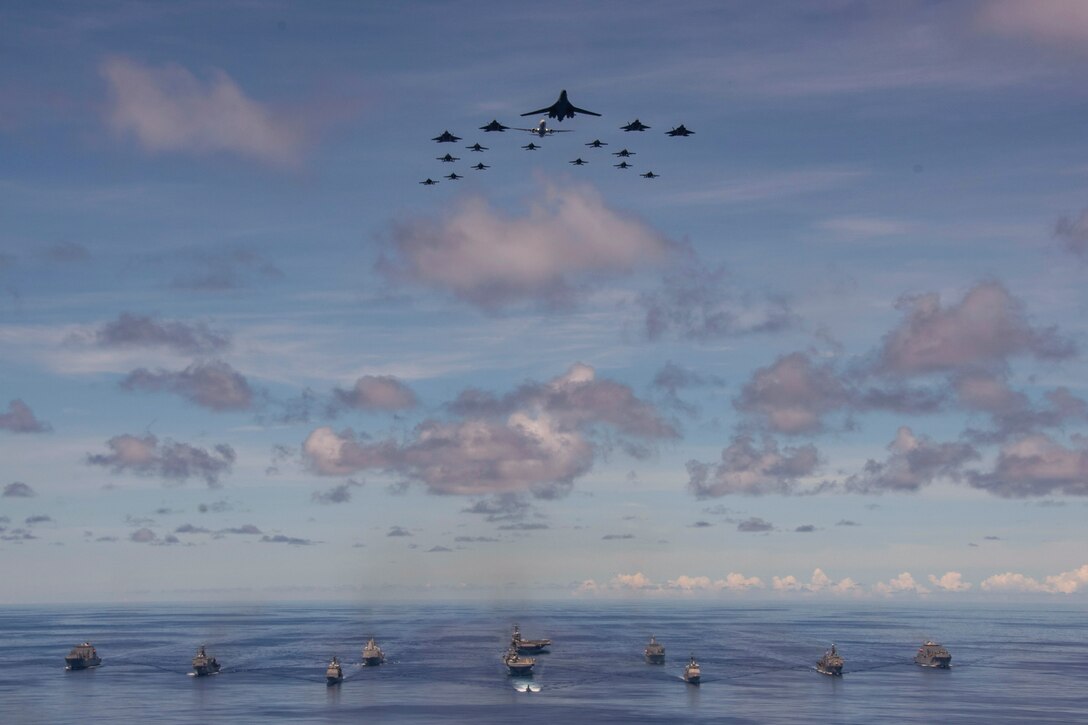
Image Credit: DoW
Left to right: The USNS Charles Drew, the USS Comstock, the USS Shiloh, the USS New Orleans, the USS Chicago, the USS America, the USS Ronald Reagan, the USNS John Ericsson, the USS Antietam, the USS Germantown and the USNS Sacagawea sail in formation with Navy and Air Force aircraft during Valiant Shield in the Philippine Sea, Sept. 25, 2020. The exercise is designed to focus on integration of joint training in a blue-water environment among U.S. forces.
Together, they represent a lethal force capable of responding quickly to any flashpoint in the region.
Japan, stepping up its regional role under growing pressure to counter communist China, deployed an impressive fleet of its own.
The helicopter destroyer JS Kaga, guided-missile destroyer JS Fuyuzuki, and attack submarine JS Jingei sailed with the U.S. formation—showing that Tokyo is more than ready to move from self-defense to serious power projection.
This marks only Japan’s second appearance in the Valiant Shield series, following its 2024 debut. The nation’s Air and Ground Self-Defense Forces are also participating, a sign of Tokyo’s expanding military capability and willingness to integrate with U.S. forces in multidomain operations.
Roughly 4,100 Japanese troops, 150 vehicles, and 60 aircraft are participating this year, according to Japan’s Joint Staff. That’s no symbolic effort—it’s a serious investment in readiness.
For a country that long hesitated to flex its military muscle, this level of involvement underscores that Japan is done playing the pacifist spectator.
The George Washington group had arrived in Guam on June 16 after leaving its homeport of Yokosuka, Japan, on May 10. The visit to Guam was both a breather and a reminder of why the island remains a critical hub for the U.S. Navy’s carrier operations. “Guam remains a critical nexus for the Navy’s carrier strike groups,” said Capt.
Nicholas DeLeo, the ship’s commanding officer. “These Sailors have been working very hard, and I’m excited they have the opportunity to recharge here in Guam before we return to sea, ready to support our mission here in the Indo-Pacific.”
Even while anchored, the George Washington’s crew didn’t just sit idle. Sailors joined community events, including cleanup projects at Naval Station Guam and local beaches.
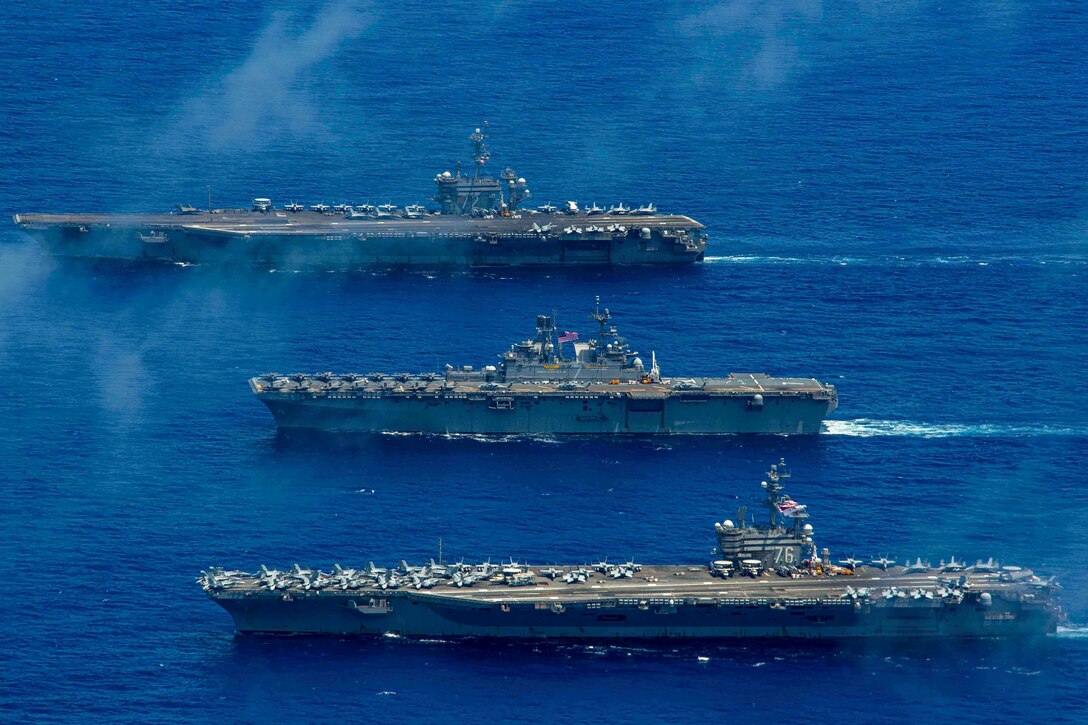
Image Credit: DoW
The USS Ronald Reagan, USS Tripoli and USS Abraham Lincoln steam in formation in the Philippine Sea, June 12, 2022, during Valiant Shield, a field training exercise.
It’s the kind of grassroots engagement that showcases America’s professionalism abroad—and the same discipline that keeps our Navy the best in the world.
Valiant Shield’s early underway period served as an unmistakable preview of what’s coming for the next ten days. The U.S. Pacific Fleet’s strategy is clear: stay ready, stay present, stay dominant.
Every operation in the Philippine Sea drives home the same truth—the Pacific belongs to free nations willing to fight for it.
With 2026 shaping up as another year of heightened tensions from Beijing’s aggressive moves in the South China Sea and Taiwan Strait, this year’s exercise carries extra weight.
The show of allied firepower is not just about drills—it’s about deterrence. It tells any adversary lurking in the shadows that if they gamble on challenging the United States and its allies, they’ll lose that bet fast.
These exercises are exactly the kind of forward-deployed readiness initiatives President Trump championed during his first term and that War Secretary Pete Hegseth continues to support with renewed energy. A strong Navy, a confident alliance, and a crystal-clear message: peace through power.
As the George Washington and her strike group cut through the Pacific, flanked by Japan’s finest, the message carries across the horizon.
In an era where weakness invites aggression, Valiant Shield reminds the world that America still leads from the front, and those who sail with her do so under the promise of strength and freedom.