U.S. Soldiers Saved by Navy Drone After Apache Crash Off Oman Coast
Posted By
Common Defense
On
In
National Security,News |
No Comments
Two U.S. Army soldiers are alive today thanks to a cutting-edge Navy drone that pulled them from peril after their AH-64 Apache helicopter went down near the coast of Oman.
The dramatic recovery, which took place Monday evening, is being hailed as one of the first known unmanned vessel rescues in American military history.
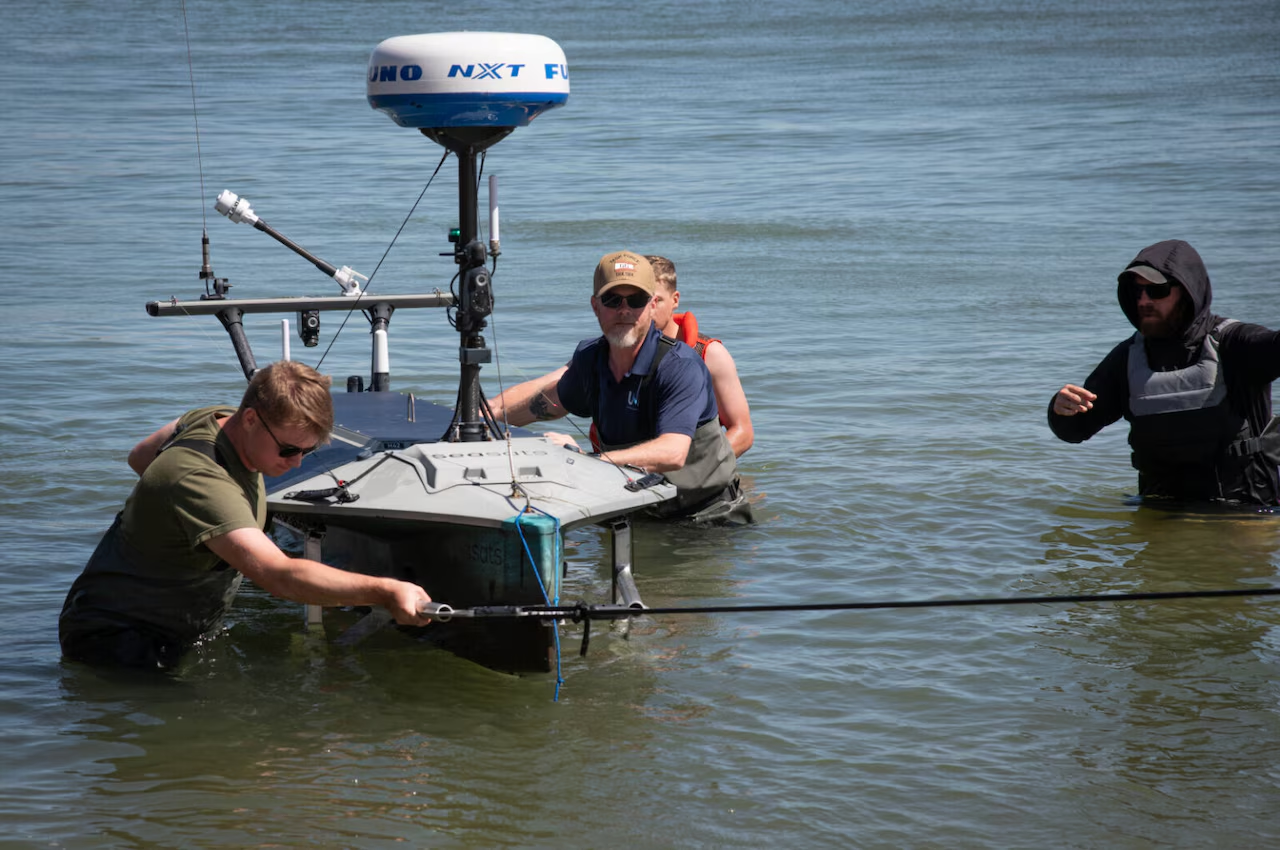
U.S. Central Command confirmed the incident, reporting that a Corsair unmanned surface vessel — operated by the Navy’s Task Force 59 — was sent in as part of the recovery mission. The soldiers were safely retrieved within two hours of the crash and are currently in stable condition.
Captain Tim Hawkins, a spokesman for CENTCOM, explained that Task Force 59 began deploying these advanced autonomous vessels in the region back in March.
“The surface drone that assisted in last night’s rescue of the Apache crew off the coast of Oman was a U.S. Navy Corsair unmanned surface vessel operated by U.S. 5th Fleet’s Task Force 59,” he said.
According to official statements, the Apache helicopter was “patrolling regional waters” at the time of the crash. The exact cause of the downing is still under investigation, but rumors are already swirling. President Donald Trump, in a statement posted to Truth Social on Tuesday, pointed the finger directly at Tehran.
Image Credit: DoW
“The United States must, of necessity, respond to this attack,” Trump warned, declaring that Iran shot down the helicopter while it was flying near the Strait of Hormuz.
If true, that would mark yet another brazen act by the Iranian regime — one that seems increasingly eager to test America’s resolve in one of the world’s most volatile waterways.
The Strait of Hormuz remains a vital artery of global commerce and energy transport, and it’s a place where rogue behavior has historically been met with tough consequences under strong administrations.
Navy assets from the 5th Fleet, alongside support from the Air Force and the 82nd Airborne Division, took charge of the emergency response. The operation showcased exactly how the United States can integrate human and unmanned systems to achieve rapid results under extreme conditions.
Image Credit: DoW
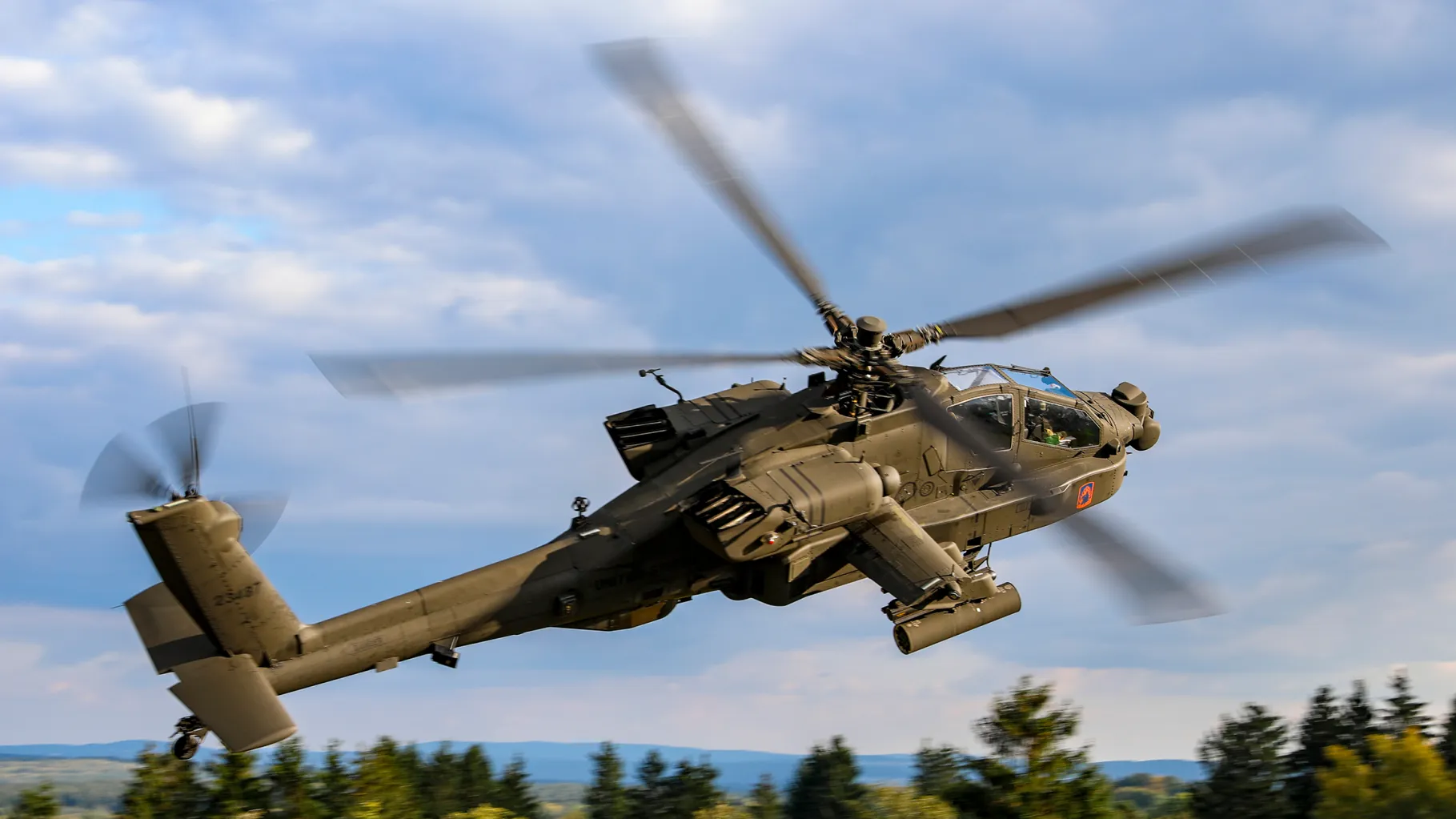
An AH-64E Apache prepares to engage during aerial gunnery training at Grafenwoehr Training Area, Germany, Oct. 2, 2025. Army photo by Spc. Josefina Garcia.
Task Force 59, headquartered in Bahrain, has become the Navy’s hub for integrating artificial intelligence and robotic systems into seaborne operations.
The unit focuses on enhancing maritime domain awareness and strengthening America’s deterrence posture in the Fifth Fleet’s region of responsibility — which spans the Red Sea, the Arabian Gulf, and, most critically, the Strait of Hormuz.
The unmanned vessel that played the starring role, the Corsair, is a state-of-the-art platform designed by Saronic. Built for rugged endurance, the 24-foot model can carry payloads exceeding 1,000 pounds and travel more than 1,000 nautical miles on a single mission.
It was precisely this blend of range, capability, and autonomy that made it perfectly suited for the rescue mission.
While details about the crash remain scarce, sources close to military officials say the immediate deployment of technology like the Corsair underscores how far the Pentagon’s unmanned warfare initiatives have come.
Image Credit: DoW
Army AH-64 Apache attack helicopters sunk several Iranian boats, U.S. officials said, as the first day of the operation to escort commercial ships through the Straits of Hormuz resulted in combat. U.S. Army photo.
Once dismissed as experimental toys, unmanned systems now play critical, life-saving roles in real-world combat environments — not simply as scouts or strike assets, but as fully functional rescuers.
Military experts note that this is an important shift in how the U.S. conducts operations across zones like the Arabian Sea and the Persian Gulf.
The military’s ability to respond quickly and decisively after the crash showcased both technological mastery and a renewed emphasis on protecting American personnel wherever they serve.
Meanwhile, President Trump has wasted little time making clear that any aggression against U.S. forces — especially in international airspace — will not be tolerated.
Image Credit: Saildrone
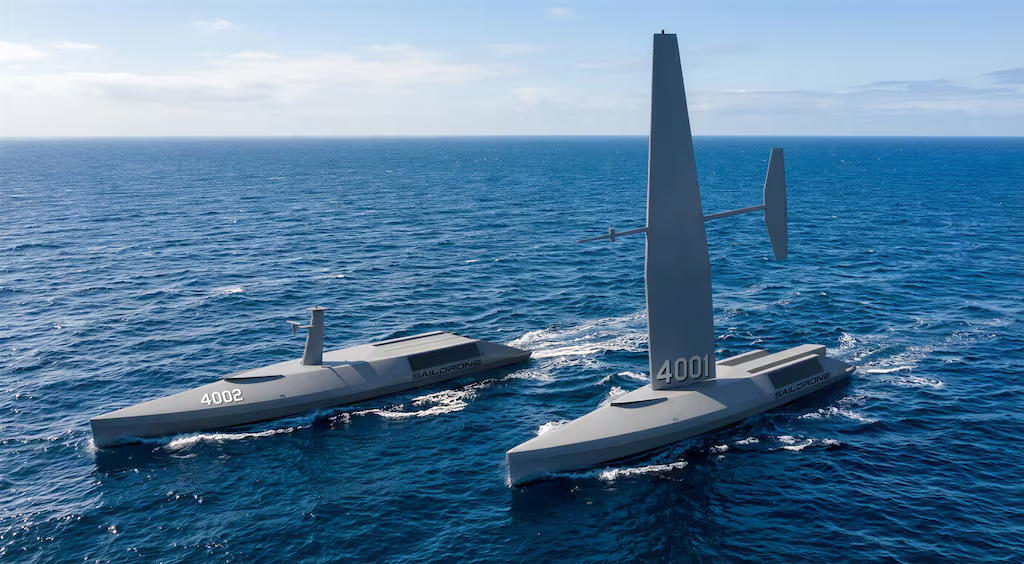
Saildrone’s Spectre design is 54 meters long and 250 metric tons, capable of a speed up to 30 knots. (Saildrone)
His declaration that “the United States must, of necessity, respond” suggests that planners are already evaluating proportional options inside the War Department.
Iran’s history of antagonizing U.S. forces in the region has long made the country a destabilizing factor, from harassing American ships to funding proxy militias.
If Trump is correct that Tehran downed the Apache, then this will likely become a major flashpoint for future military posture in the region.
For the soldiers rescued, Monday night’s nightmare ended with the hum of an unmanned craft pulling them from the dark waters.
It’s a reminder that while America’s adversaries may look for weakness, this nation’s warriors always have innovation, coordination, and grit on their side — and under the leadership of President Trump and War Secretary Pete Hegseth, that edge is sharper than ever.
The rescue near Oman wasn’t just a save; it was a preview of the future of warfare — one in which machines and men work together under a single mission command: bring every American home.