U.S. Would Need 1,200 Troops to Take Iran’s Oil Hub, Kharg Island, Experts Warn
Posted By
Common Defense
On
In
National Security,News |
No Comments
If President Donald Trump gives the order to seize Kharg Island, the small but strategically vital outpost off Iran’s coast, experts estimate roughly 1,200 U.S. troops would be needed to take control.
The mission could represent one of America’s most high-stakes power moves in the Persian Gulf in decades, especially as Kharg handles nearly 90 percent of Iran’s crude exports.
For now, no direct orders have been issued. But Trump’s prior statement that Kharg Island may soon be “taken” set off waves of speculation among military planners.
Although he later paused further strikes against Iran, his message was loud and clear: America’s patience with Tehran’s aggression is wearing thin.
Kharg Island, just 15 miles off Iran’s coast, is roughly eight square miles in size with around 8,000 residents. That geography poses challenges but also opportunities.
Retired Army Gen. Joseph Votel, former commander of U.S. Central Command, believes capturing the island would require a battalion to brigade-sized force—about 1,200 to 4,000 troops.
The final number would depend on mission specifics, he said, but the force must be self-sustaining and ready to repel counterattacks.
According to Votel, success would hinge not just on the landing, but on maintaining situational control amid Iranian missile and air threats.
“The specific tasks to be accomplished will actually drive the size of the force,” he noted, emphasizing the need for robust logistics, air support, and engineering elements.
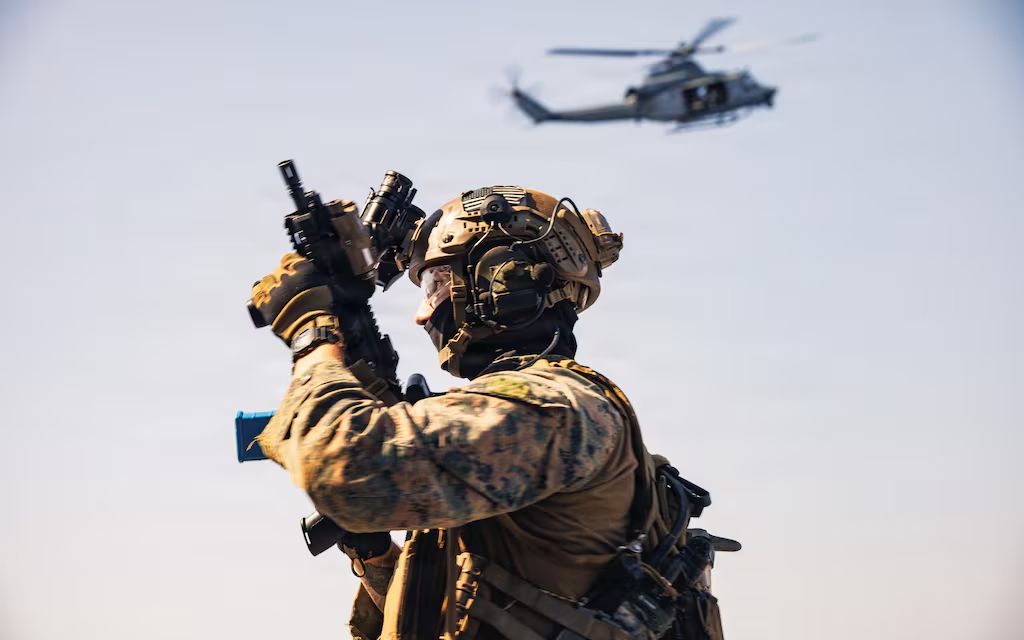
Image Credit: DoW
A Marine with Force Reconnaissance Platoon, 31st MEU, during an exercise in the Philippine Sea, Feb. 4, 2026. (Lance Cpl. Victor Gurrola/U.S. Marine Corps)
Jonathan Schroden, a Marine Corps force design expert with CNA, argued that a Marine Expeditionary Unit (MEU)—roughly 1,200 Marines—could execute the seizure operation.
Amphibious assaults are core Marine capabilities, and Kharg’s size fits the MEU’s operational envelope. However, holding the island would require significantly more manpower to protect against Iran’s rapid retaliation.
“It’s worth noting that a Marine Expeditionary Unit brings with it a reinforced infantry battalion of about 1,200 Marines and amphibious seizure operations are a core capability of that unit,” Schroden said.
“Holding it might require more than that—depending on, for example, how much of a threat the 8,000 Iranian residents might pose—so some amount of follow-on forces might also be required.”
Given Iran’s missile range, any U.S. foothold on the island would be under constant threat. Schroden warned that steady exposure to air and missile attacks would require unparalleled levels of air defense support.
That could mean a mix of onboard assets, ship-based missiles, and aviation cover from the broader Marine and Navy network.
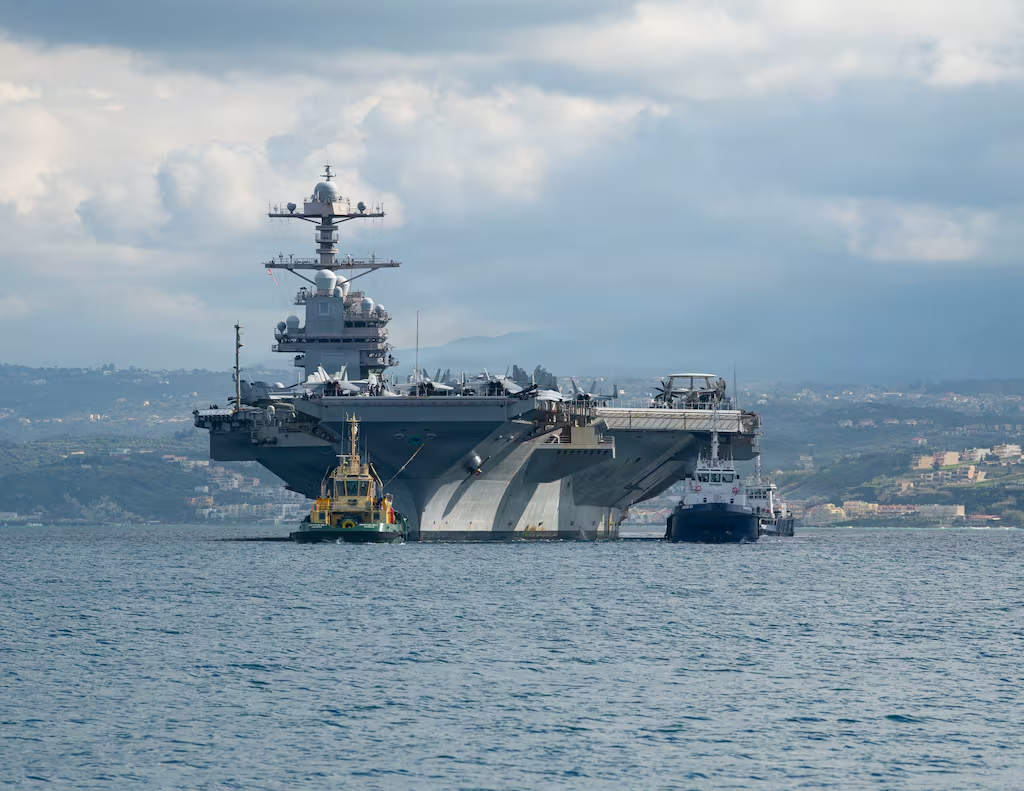
Image Credit: DoW
The Gerald R. Ford-class aircraft carrier USS Gerald R. Ford, seen here in Souda Bay, Greece, cost roughly $13 billion to manufacture. (MCS3 Hannah Donahue/U.S. Navy)
A retired senior War Department official also agreed that about 1,200 troops would be necessary, likely composed of a Marine battalion landing team or a reinforced Army airborne battalion.
Taking the island, he said, would be the easy part. Holding it would demand engineers, air cover, and a rapid response capacity to suppress Iranian rocket fire.
“Taking the island would be less risky than holding it,” the official said. American troops would have to dig in, harden positions, and sustain supplies under fire if they were to hold the ground for longer than a short-term strike.
Analysts compare the challenge to past special operations missions. Caitlin Talmadge of MIT noted that capturing Kharg Island would be far more complex than the Venezuelan capture mission.
“An airborne landing could be difficult due to the island’s terrain and civilian population, and an amphibious operation so close to the Iranian mainland could leave U.S. forces vulnerable to Iranian attacks,” she explained.
She also emphasized the logistics behind sustaining such an operation. Even assuming a clean insertion, maintaining a continual flow of supplies and reinforcements across waters controlled by Iranian naval assets presents real risk.
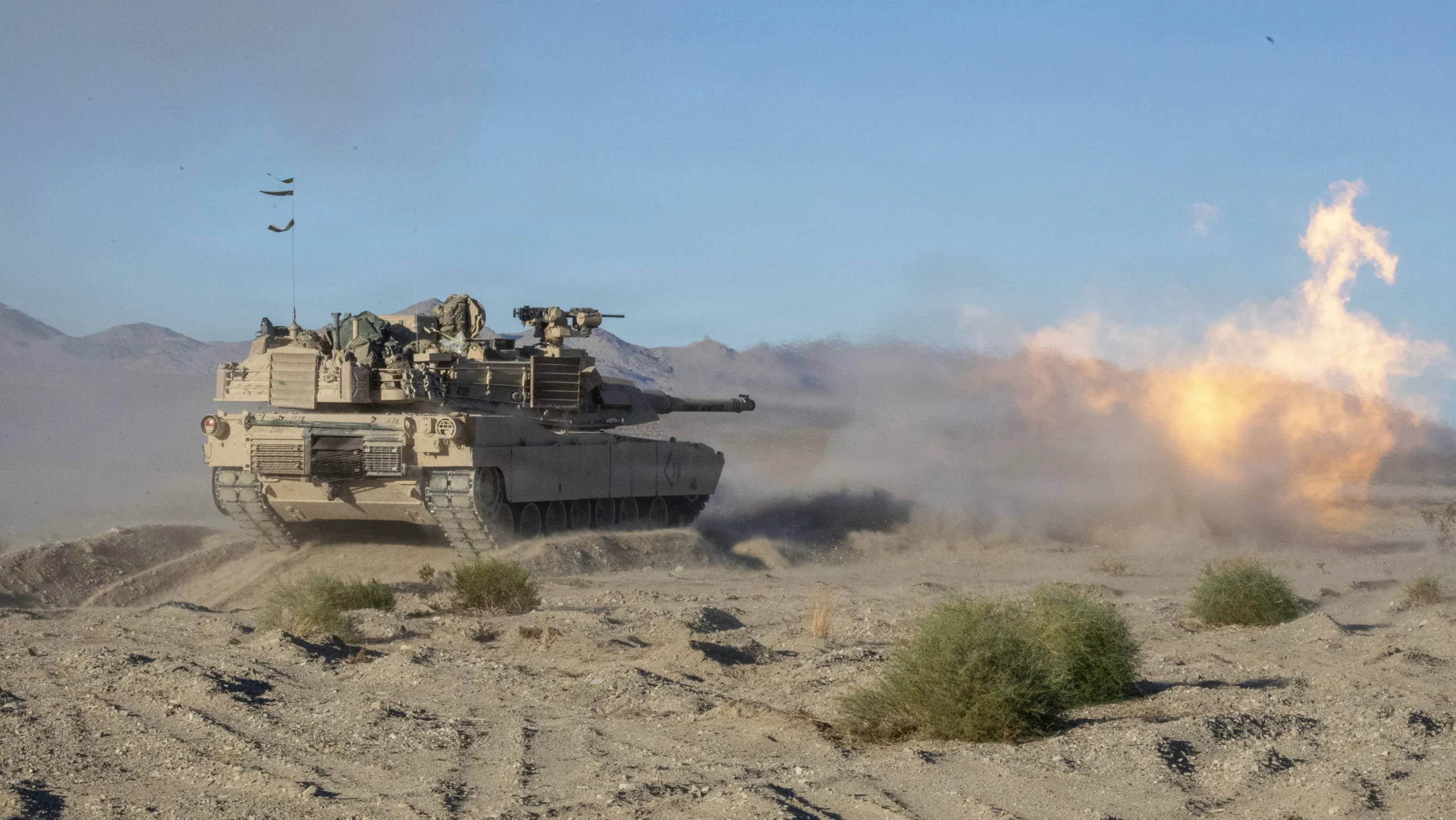
Image Credit: DoW
1st Armored Brigade Combat Team soldiers fire an M1 Abrams during a rotation at the National Training Center at Fort Irwin, California. This unit will get the new M1E3 Abrams tank prototype in the fall. Army photo by Cpl. Michael McClary.
Despite the operational hazard, the geopolitical and economic impact of taking Kharg would be monumental. Choking off Iran’s oil exports by taking control of its main terminal would strike at the regime’s economic lifeline.
It would send a message that Washington is through tolerating Tehran’s provocations—especially after years of sabotage, maritime harassment, and nuclear defiance.
Military strategists note that a successful Kharg seizure would demonstrate U.S. dominance in the Gulf and could serve as leverage in future negotiations. It could also solidify regional alliances with Arab partners who have grown frustrated by Iran’s intimidation tactics.
The operation would not be without cost or complexity, however. Logistics would need to be flawless, with naval forces controlling maritime lanes and constant air supremacy to prevent Iranian interference.
The U.S. would also need to plan for rapid extraction should circumstances demand it.
In essence, the picture emerging from military experts is clear: a swift strike could be done with 1,200 troops, but staying power would demand far more. The balance between risk and reward would rest entirely on whether President Trump deems the payoff worth the peril.
Trump has never been shy about using strength to force peace. And if the War Department ever receives the green light, the takedown of Kharg Island would prove once again that deterrence works best when backed by American resolve and overwhelming force.