Japanese Torpedo Sinks Former US Warship in ‘Valiant Shield’ Strike in the Pacific
Posted By
Common Defense
On
In
National Security,News |
No Comments
A Japanese submarine sent an American warship to its watery grave this week during the massive Valiant Shield joint exercise, a show of raw allied firepower being staged across the Pacific from June 22 to July 1.
The unarmed target was the decommissioned USS Juneau, an Austin-class amphibious transport dock that served the nation through Vietnam and Desert Storm before being laid up in Pearl Harbor.
Now, the ship rests on the seabed more than 200 nautical miles off the coast in the Mariana Islands Range Complex, following a precise torpedo hit delivered by the Japan Maritime Self-Defense Force.
The exercise, known as a SINKEX (sinking exercise), was designed to sharpen the warfighting coordination of the U.S. and its closest Pacific allies while testing lethal capabilities under real-world conditions.
Rear Adm. Eric Anduze, commander of Carrier Strike Group 5 and Task Force 70, praised the demonstration as more than a symbolic event.
“This SINKEX provided an outstanding opportunity for our joint team to integrate capabilities across domains, honing the lethal precision and coordination essential for high-end maritime operations in the Pacific theater,” he said.
Valiant Shield is no small-time drill. It brings together forces from the United States, Japan, Australia, Canada, and New Zealand in a sweeping test of combat readiness across air, sea, land, space, and cyberspace.
The focus is simple but serious: make sure America and her allies can find, track, and destroy targets in the Indo-Pacific if real war ever comes knocking.
The significance is not lost on strategic observers who recognize China’s increasingly aggressive maneuvers in the region.
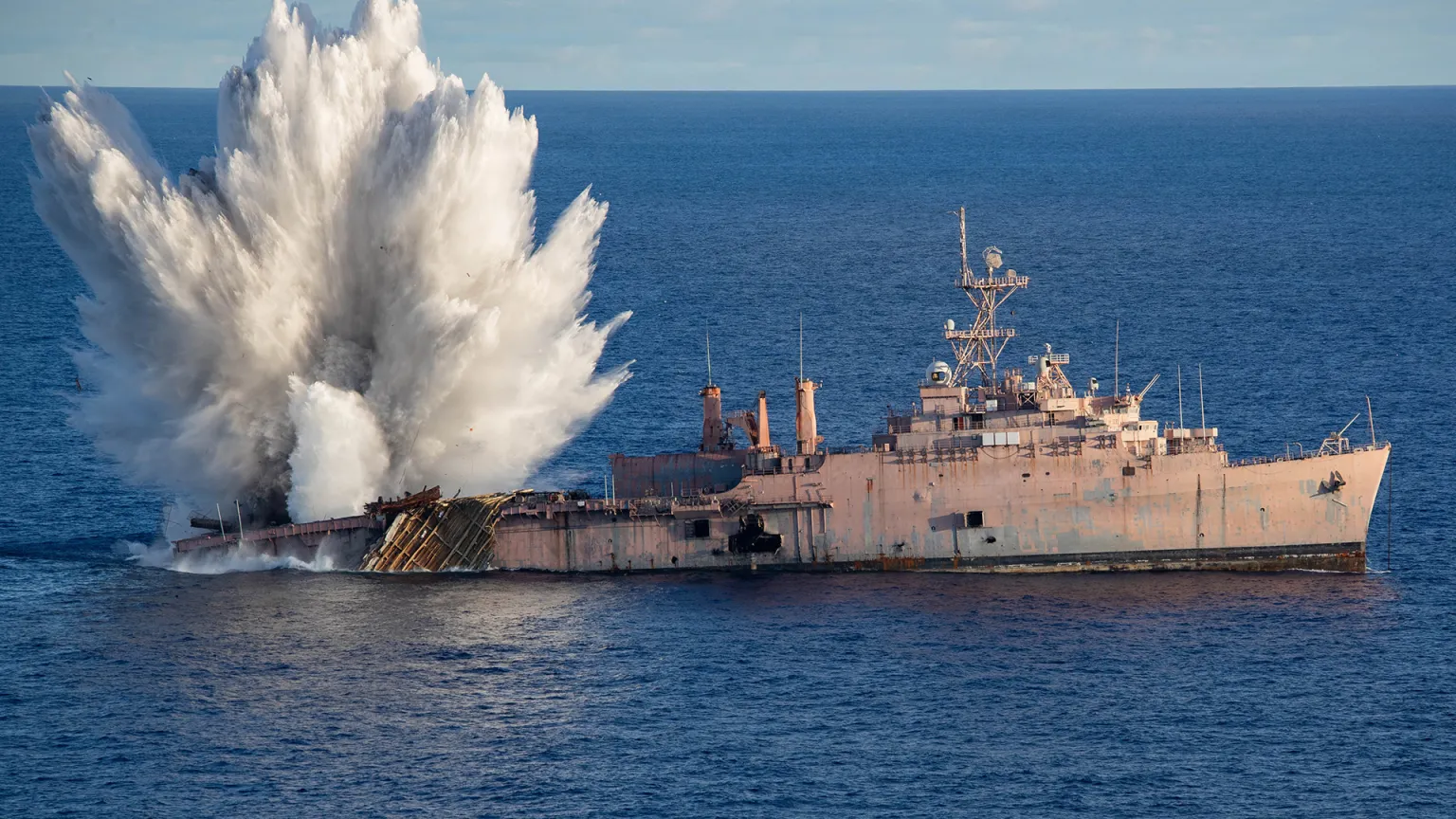
A torpedo hits the decommissioned amphibious transport dock USS Juneau as part of a ship sinking exercise on June 27, 2026. Navy photo by Mass Communication Specialist Seaman Anthony Vilardi.
Exercises like Valiant Shield send a crystal-clear message to Beijing — the Pacific isn’t theirs to claim, and the Western alliance still dominates the seas. Every time an allied ship or jet takes part, it reinforces deterrence and signals unity against communist expansion.
The USS Juneau had quite the history before her controlled sinking. Commissioned in 1969, she saw service during the Vietnam War and took part in Operation Desert Storm decades later.
Her decommissioning in 2008 marked the end of nearly four decades of service. But rather than rusting away in a dockyard, Juneau now trains the next generation of warriors — a noble final act for a battle-tested American vessel.
Before any ship is sunk in a live-fire event, the War Department ensures it’s cleaned to rigorous environmental standards.
The Navy confirmed that the Juneau underwent an exhaustive process to remove all hazardous materials, including liquid polychlorinated biphenyls (PCBs), mercury, fluorocarbons, and petroleum left in tanks and piping. Even the smallest potential contaminants are extracted before a vessel is transferred for a SINKEX.
Navy environmental and safety officials inspect every step of the process. That diligence ensures that while the exercise demonstrates immense firepower, it does so without polluting the Pacific or damaging marine ecosystems.
It’s a balance between training aggressiveness and environmental responsibility — something the U.S. Navy takes seriously, despite left-wing critics who constantly harp about “waste” and “pollution.”
The live-fire nature of Valiant Shield also allows crews to work with real-time targets under real pressure, something simulations simply cannot replicate.
Weapons accuracy, coordination timing, communication reliability — all these factors only become fully testable in the chaotic, unpredictable space of live warfighting maneuvers.
Image Credit: DoW
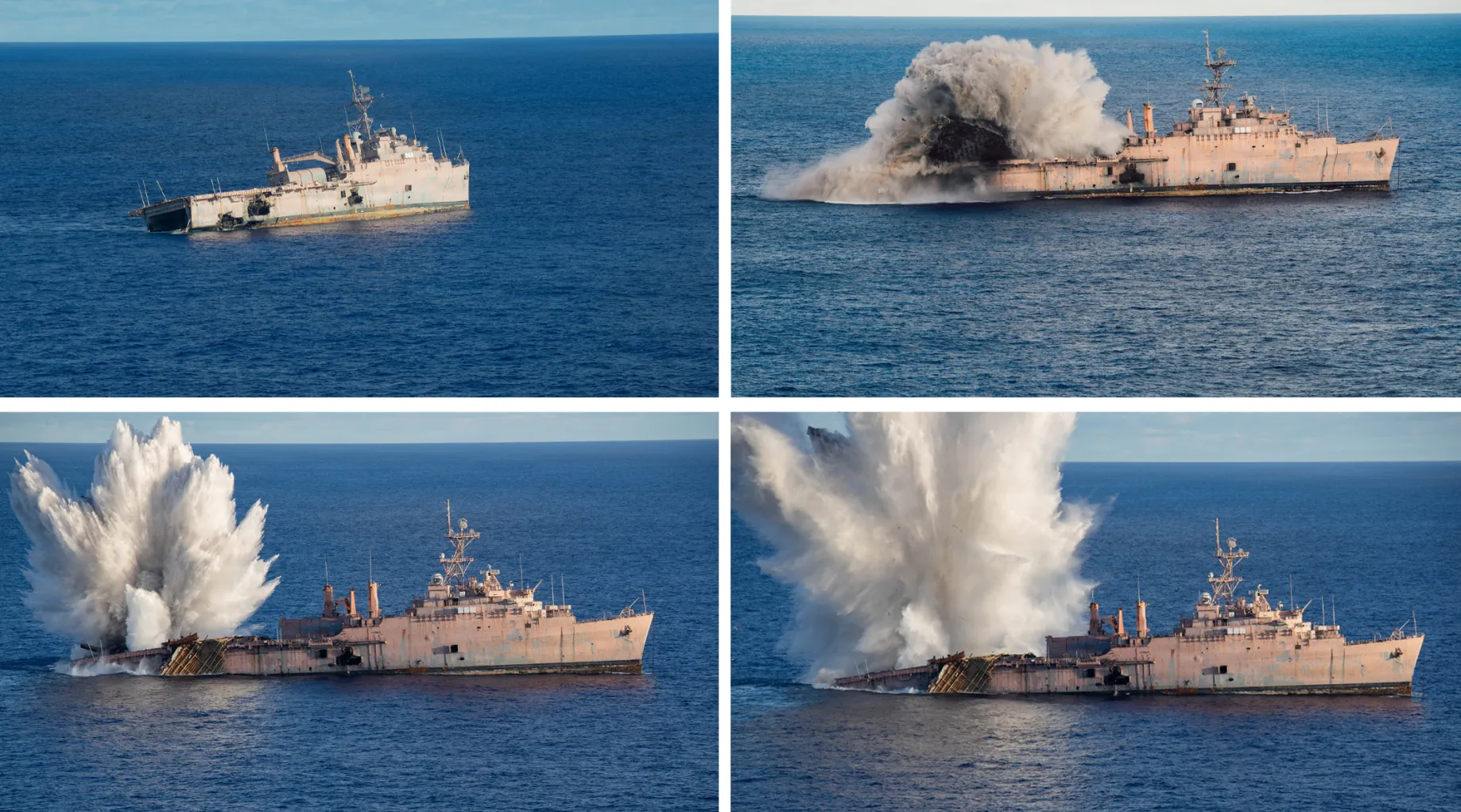
Photos of the USS Juneau showing the moments leading up to and immediately after impact by a torpedo during the June 27, 2026, ship sinking exercise. Navy photos.
Every missile, bomb, and torpedo fired in Valiant Shield means sharper preparedness for the conflicts no patriot hopes will come, but every warrior must be ready to fight.
The partnership between U.S. and Japanese forces remains one of the most crucial in the Indo-Pacific.
Japan’s participation with advanced submarines and precision weapons like the one used against the Juneau demonstrates how far the postwar alliance has evolved into a genuine, hard-edged defense cooperation pact.
This is deterrence through strength — the very doctrine that President Trump and War Secretary Pete Hegseth continue to advocate as the bedrock of peace.
Through a conservative lens, exercises like Valiant Shield reflect a reassuring return to seriousness in national security.
No social engineering nonsense, no political gamesmanship — just pure readiness, joint strength, and mutual trust between militaries determined to deter tyrants. The Pacific is being fortified not through talk, but through training and steel.
Sinking an old warrior like the Juneau isn’t destruction; it’s transformation. In death, she continues to serve, offering real-world training that keeps sailors and allies prepared.
The sight of that ship disappearing beneath the waves is not a loss, but a salute — a salute to American naval dominance, allied unity, and the enduring principle that peace is preserved only through unmatched might.
In the broader picture, Valiant Shield reminds the world that the U.S. and its partners are not spectators in the Pacific but active guardians of freedom.
While adversaries rattle sabers, this exercise proves the West still commands the theater with unmatched precision and resolve. And one old American vessel just helped make future victories that much more certain.