New Marine Scout MOS Officially Launches, Bringing Eyes and Ears to the Modern Battlefield
Posted By
Common Defense
On
In
National Security,News |
No Comments
The Marine Corps just made a major move toward the future of ground combat with the official launch of the new Marine Scout career field.
Starting October 1, Marines will see the activation of the new 0315 “Scout” Military Occupational Specialty, marking a structural shift in how the Corps conducts reconnaissance and battlefield intelligence.
For months, hints of this change were circulating among Marine circles, but confirmation came this week when Corps officials announced the creation of dedicated Scout Platoons within infantry battalions.
Each will consist of 26 Marines, forming small, agile reconnaissance teams designed for high-speed, high-precision battlefield operations.
According to a Marine Corps release, these units will be loaded with next-generation gear like advanced optics, battlefield drones, and high-end communications suites to maintain eyes on enemy positions across dynamic fronts.
Each team will also include a Joint Fires Observer capable of calling in deadly and precise air and artillery strikes when necessary.
Lt. Gen. Jay M. Bargeron, deputy commandant for plans, policies, and operations, called the move a cornerstone of future combat readiness.
“This professional, purpose-built force will provide commanders with the organic reconnaissance and surveillance capabilities essential for success on the future battlefield,” he explained.
“These scouts will be our eyes and ears, extending our sensing capabilities and enabling commanders to make faster, more effective decisions to win our nation’s battles.”
For the Marine Corps, this is about far more than just adding another box on the unit roster. It’s about evolving warfare culture—about once again ensuring that Marines remain the sharp edge of American military might.
Image Credit: DoW
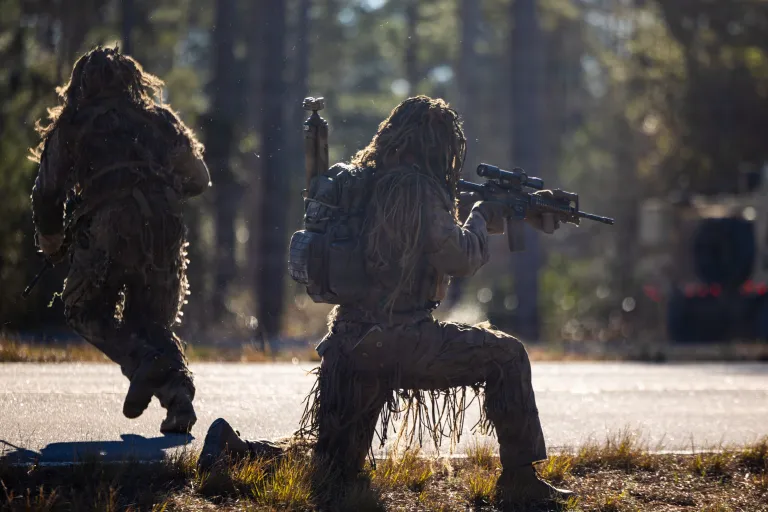
A Marine infantry scout with 3rd Battalion, 2nd Marine Regiment, 24th Marine Expeditionary Unit, holds security during a live-fire range on Marine Corps Base Camp Lejeune, North Carolina, Jan. 13, 2026. Marine Corps photo by Lance Cpl. Brian Bolin Jr.
Bargeron’s comments underscore that this is a strategic pivot, not a bureaucratic shuffle. The new MOS aims to fill a critical gap in organic intelligence collection and target spotting, giving ground commanders a permanent set of tools for immediate action.
Maj. Gen. Michael A. Brooks, who oversees Training Command, elaborated on how deeply the move will reshape Marine training pipelines.
“We’re interested in turning our Scout MOS, which is 0315, into a primary MOS,” Brooks said earlier this year. “It would be like, you know, a machine gunner, or 0331; or mortarman, 0341. You’d have an 0315 Scout as a primary MOS. We don’t do that right now. It’s an additional MOS.”
The goal is simple: sharpen the Marines’ reconnaissance edge through specialization, rather than relying on broad auxiliary training.
When the change becomes official, Scouts will likely attend a new Ground Reconnaissance Course that will serve as their formal pipeline to becoming fully certified under the 0315 field.
The Marine Corps is emphasizing the “professionalization” of these Scouts, signaling that formal, dedicated recon expertise is back in a big way.
Lt. Col. Worth Parker, a retired reconnaissance and special operations officer, drew a clear distinction between these Scouts and traditional Recon Marines.
“Scouts and Reconnaissance Marines both provide commanders with intelligence, but Reconnaissance Marines typically operate at greater distances beyond the forward edge of the battle area,” he explained. Scouts, on the other hand, are designed for rapidly gathering tactical ground truth just ahead of maneuver elements.
To put it in real terms, Parker offered a familiar battlefield example. “Let’s say a rifle company is going to assault an objective,” he said.
“You might use the Scouts to find a route to the objective and then bring them back to link up with the company commander to take that company on to where they have to go.” That level of on-the-ground precision can determine whether a mission is a clean success or a costly mess.
The introduction of the new career field also reflects a cultural reaffirmation of what makes the Marine Corps unique: the ability to adapt fast, train hard, and fight smart.
From embassy security to island hopping to brutal urban engagements, the Corps has always valued its scouts as force multipliers. This new MOS simply modernizes and formalizes that long-honored warrior tradition.
Tactically, expect these new Scout teams to become linchpins in the Corps’ restructured force concept aimed at distributed maritime operations.
Whether operating alongside light armored reconnaissance units or in direct support of infantry battalions, the new 0315 Marines will expand the Corps’ reach and situational awareness on unpredictable, contested terrain.
This move comes as the War Department continues to prioritize readiness and adaptability under renewed America-first leadership.
With rising global instability, the ability to deploy smarter, decentralized reconnaissance forces is not just smart policy—it’s national survival.
From the brass in D.C. to the fire teams preparing for the next fight, this development shows a Corps still committed to doing what it does best: adapting on the fly and preparing to win.
It’s another reminder that even in an era of drones and satellites, there’s still no substitute for a Marine’s eyes on target.
And with America’s new War Department leadership focused on restoring military lethality under Secretary Pete Hegseth and President Trump’s direct emphasis on strategic readiness, the timing couldn’t be better.
The 0315 Scout is not just another Marine—it’s the embodiment of the Corps’ return to its combat-first fundamentals.