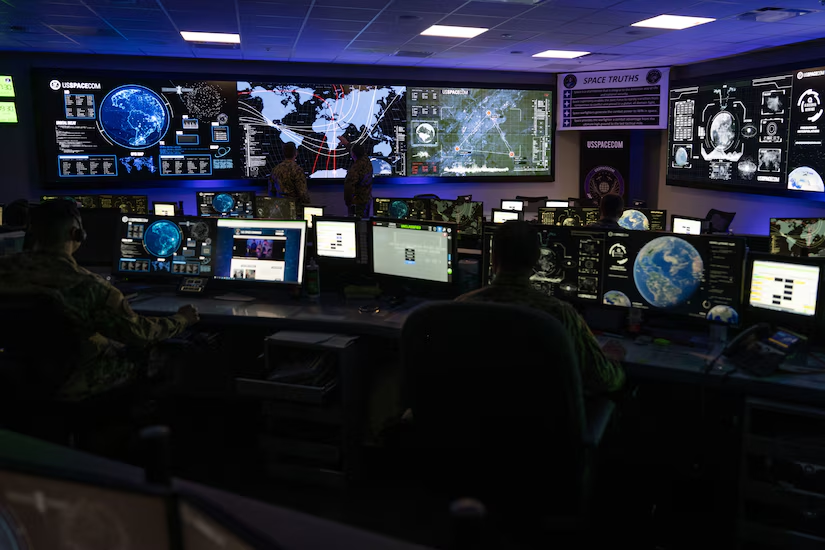
After years of development and quiet investment, the United States Space Force has officially declared operational one of its first real-deal weapons — a ground-based system capable of jamming and neutralizing enemy satellites.
The “Meadowlands” system represents a new chapter in the projection of American military power into the final frontier — space.
The Meadowlands system, built by L3Harris Technologies, isn’t a missile designed to shatter enemy equipment into orbiting debris.
Instead, it’s a precision electromagnetic warfare weapon using radiation to “detect, deny, disrupt, and degrade” an adversary’s satellite systems.
In simpler terms, it can shut down hostile communications, geolocation trackers, and surveillance feeds in space — all without firing a kinetic shot.
Stationed under Mission Delta 3 at Peterson Space Force Base in Colorado, this weapon joins the Space Force’s growing list of real capabilities rather than symbolic projects. Guardians, the service’s elite operators, now have a tool that lets them engage in combined arms operations even across the boundary between Earth and space.
What makes this system especially clever is its reversibility. Unlike a missile or debris-creating weapon, the Meadowlands can jam a satellite for as long as necessary and then “unjam” it when conditions change. No permanent damage, no space junk, no diplomatic headache. It’s surgical warfare for the information age.
Col. Angelo Fernandez, who commands Mission Delta 3, emphasized how vital continuous modernization is.
“Continued U.S. Space Force investment in electromagnetic warfare systems, software, and advanced training is essential to modern warfare,” he said. His statement reads more like a challenge to keep pace with growing threats from China and Russia, who have made no secret of their own anti-satellite ambitions.
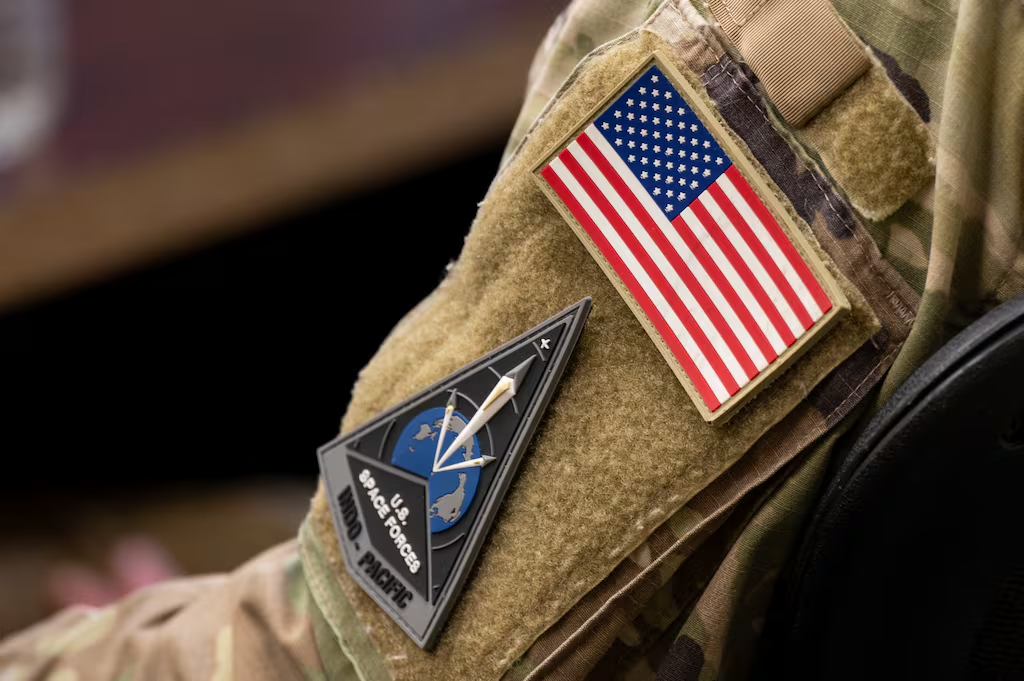
The hardware looks simple to the untrained eye — a large dish antenna mounted on a mobile trailer. But that simplicity hides decades of sophisticated development.
The system traces its roots back to the Counter Communications System first put in place in 2004. What once required large stationary equipment can now fit on mobility platforms, meaning these systems can be relocated fast or even airlifted inside cargo planes.
That flexibility matters, especially in a world where potential flash points spread across multiple theaters. A unit stationed at Peterson can be deployed to “forward austere environments” quickly, providing electromagnetic superiority wherever American forces set up operations.
The Space Force has been quietly proving its value in recent joint missions, particularly Operations Midnight Hammer and Absolute Resolve. In these real-world scenarios, Space Force’s jamming and satellite operations helped pave the way for American and allied forces to operate unchallenged.
Gen. Dan Caine, Chairman of the Joint Chiefs of Staff, credited the Guardians for creating vital pathways for U.S. special operations missions earlier this year in Venezuela.