
The Pentagon is charging ahead with its plan to reassert American supremacy in the drone battlefield, officially naming the five winners of its high-stakes Lethality Prize Challenge under the $1.1 billion Drone Dominance program.
The goal is simple yet potent: arm America’s small drones with cost-effective, mass-producible explosive power to crush adversaries at scale.
The War Department’s Defense Innovation Unit rolled out the results last month, recognizing Bravo Ordnance, Kela Technologies, Kraken Kinetics, Mountain Horse Solutions, and Northrop Grumman for crafting lethal payloads that can be easily integrated with attack drones.
These aren’t just science projects; they’re the building blocks for the unmanned warriors that will dominate the skies in the fights to come.
MORE NEWS: Senator Warns Government Shutdown Looms as Democrats Balk at Trump’s Defense Budget Surge
While the Lethality Prize offered just $10,000 in cash, the true reward is far greater.
These companies now hold the inside track to supply the Pentagon’s “preferred munitions” for one-way attack drones, giving them a foothold in what could become one of the most consequential military contracts of the decade. In an era where drone warfare defines power projection, that’s a big deal.
Northrop Grumman, a towering name in the defense-industrial world, walked away with one of the top selections for its Common UAS Payload—a weapon that’s “ready to integrate and deploy immediately,” according to Tanya Santers, the company’s director of fuzes and warheads.
Northrop has spent more than $2 billion developing the tech and facilities needed to meet the War Department’s strict standards, proving that longstanding experience still counts for something in modern warfare.
![Arctic Front Flares Up: FPV Drones Redefine Arctic Warfare After Ukraine [WATCH]](https://www.commondef.com/wp-content/uploads/2026/03/2026.03.14-03.45-commondefense-69b58297e6199.avif)
The competition, however, also spotlighted the bold rise of smaller, scrappier firms looking to challenge the old guard. Texas-based Bravo Ordnance, launched in 2025 on just $3.5 million in venture funding, is already making noise.
The veteran-led company, founded by former Navy and Army serviceman Devan Plantamura, touts its ability to build custom warheads in “two weeks or less.” As Plantamura bluntly put it, without a warhead, an attack drone is “just a flying object.”
Then there’s Kela Technologies—an Israeli startup born out of the chaos of the October 7 attacks. Founded in 2024, the company was originally a software integrator helping Western allies merge commercial tech into military systems. But with millions in Silicon Valley and CIA-backed IQT funding, Kela quickly grew into a drone powerhouse.
With a $1.2 billion valuation, its collaboration with Autonomous Guard has turned it into a cross-border tech juggernaut pushing hard into the lethality space.
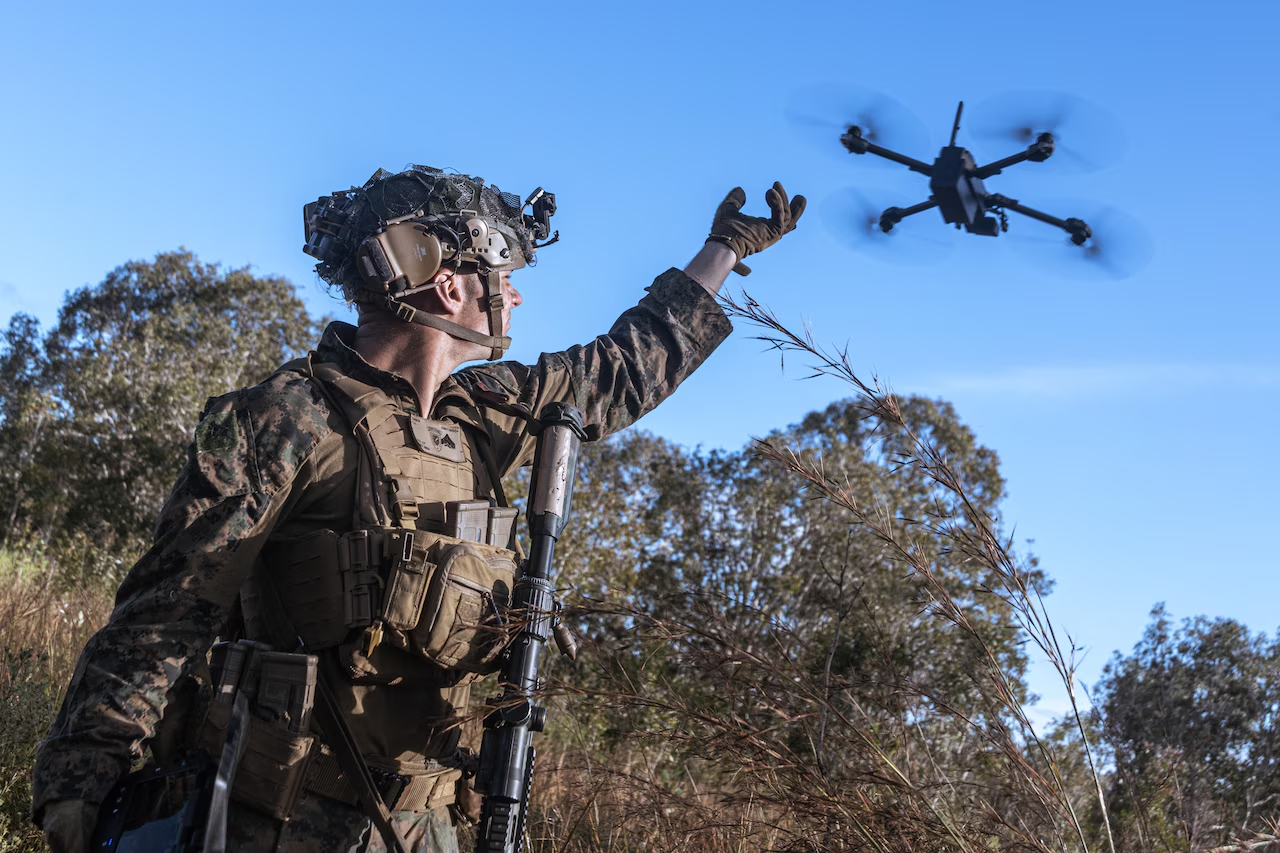
Kraken Kinetics, out of North Carolina, made its own mark by designing its Terminus warhead for first-person-view (FPV) attack drones.
The company has already demonstrated the system to elite units like the Army Rangers and Marines, reinforcing that America’s warfighters are actively testing, trust-building, and sharpening the edge of this new generation of drone munitions.
Kraken designed its payload to be adaptable, connecting quickly to commercial drone platforms using standard Electronic Safe and Arm Devices.
Colorado-based Mountain Horse Solutions rounded out the winners with a design crafted to work with “any drone on the market.” The company, an offshoot of Global Ordnance, has carved its own niche since its founding in 2014.
President Bill Allen summed up his team’s spirit perfectly, calling the challenge “exactly the kind of problem set we are built for—delivering adaptable, scalable lethal solutions that keep pace with the lightning-fast evolution of drone warfare.”
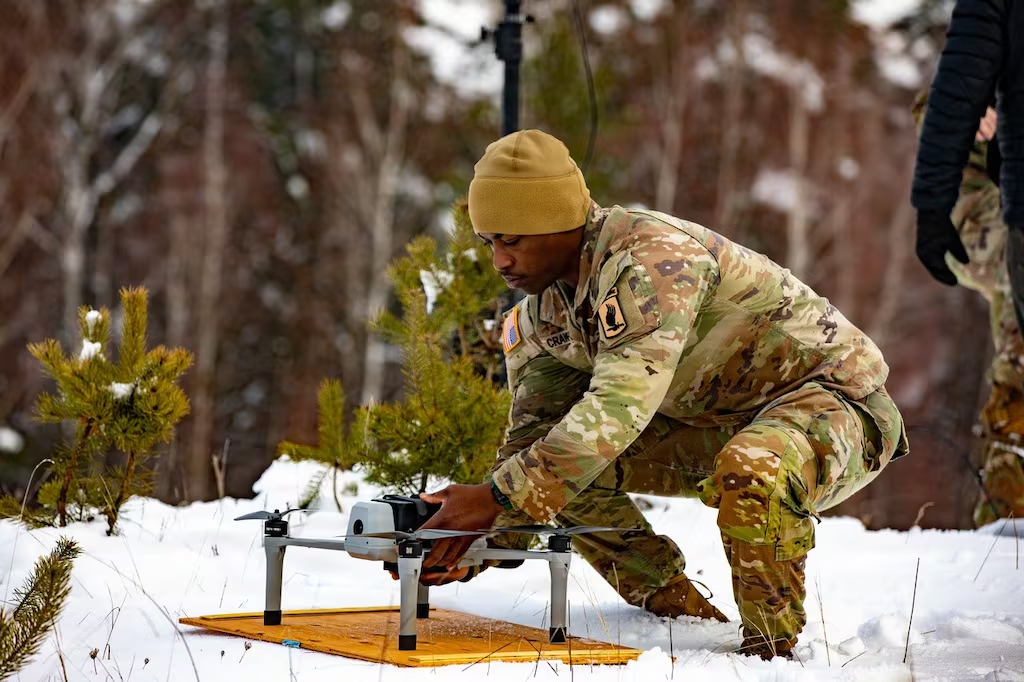
The Pentagon isn’t playing small ball with the Drone Dominance program. Kicked off in July 2025, the initiative aims to acquire roughly 300,000 drones by 2028 through a three-phase effort.
The War Department is aggressively pushing to slash the average cost per drone from about $5,000 to $2,300, a practical move to ensure that numbers, not just precision, define future combat advantage.
Currently in its second phase, the program is evaluating 79 drone systems from 49 companies for both long-range strike and close-quarter missions.
After rigorous testing, only a few select manufacturers will make it to the final phase this November, when the Pentagon will conduct the ultimate field tests before full-scale production begins.
Behind all the defense jargon and contracts, this is a clear message to Beijing, Tehran, and Moscow: America’s arsenal is adapting fast, and it’s adapting hard.

While rivals lean on cheap drones and questionable tech to project force, Washington is putting muscle behind scalable engineering and combat-ready innovation engineered within our own industrial base.
This is precisely the kind of strategic modernization long overdue at the Pentagon. Years of bureaucratic drift and globalist restraint under previous administrations left America’s drone capability lagging.
But now, with leaders focused on national strength over political correctness, the tide is turning. The sky won’t belong to our enemies—it’ll hum with the sound of American-made power, precision, and purpose.
The Lethality Prize Challenge shows what happens when defense innovation meets warrior necessity. It’s not just another contract competition.
It’s a statement that under this new era of wartime readiness, the War Department isn’t waiting for the next threat—it’s building weapons to meet it head-on.
The opinions expressed by contributors and/or content partners are their own and do not necessarily reflect the views of RobManess.com. Contact us for guidelines on submitting your own commentary.
Join the Discussion
COMMENTS POLICY: We have no tolerance for messages of violence, racism, vulgarity, obscenity or other such discourteous behavior. Thank you for contributing to a respectful and useful online dialogue.